"Images seem to speak to the eye, but they are really addressed to the mind.
They are ways of thinking, in the guise of ways of seeing."
--William Duff
The Warka Vase
around 3000 BCE
 |  |  |
|---|---|---|
 |  |
Material: alabaster stone
Size: about 3 ft tall
I have given you several images of this vase:
-
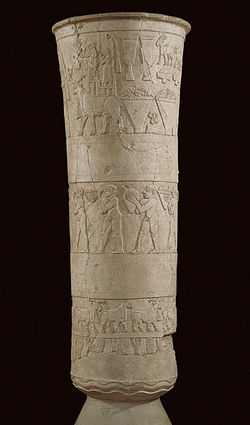
Image 1 is a photograph of the entire vase.
-
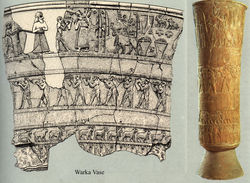
Image 2 is a drawing of what the vase would look like if it were flattened out--I gave you this image so that you could clearly see all the figures.
-
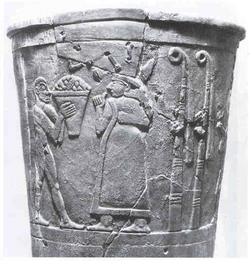
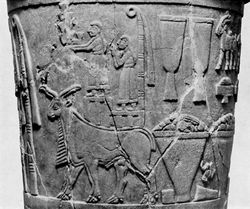
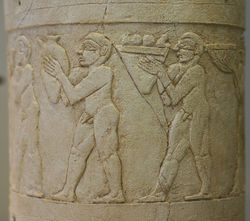
Images 3 & 4 show close-up views of what's going on in the top register of the vase. Since the vase is round, it is difficult to get a clear view of the entire scene, which wraps around the vase. Image 3 shows several figures, including one who faces left; Image 4 shows what is located behind the figure facing left.
-
Image 5 is a closer view of the middle part of the vase.
First, take a minute or two to look closely at the vase in the images above. Write down your reaction to it--what did you think about when you first saw this? What parts of this artwork caught your eye? Why did you pick this vase for your response paper? Make notes on things that you notice about it. Also, write down any questions you have about it--what kinds of things would you want to know about this vase? Remember the questions we ask in class. You don't need to have answers for these questions yet, but keep them in your notes.
Once you have some questions written down, try to answer them by reading the information I've provided below about the vase and its context.
Context: Where Was It Found?
The vase was made around 3000 BCE in the city of Uruk, in what is today the country of Iraq. Back then, this was a land called Sumeria. The Greeks later called it Mesopotamia, because it was the "land between two rivers". The city of Uruk was located near the Euphrates river, and several canals carried its waters throughout the city.
Around the time this vase was made, Uruk was a major center of culture and wealth. It is estimated that 50,000-80,000 people lived in this city--which made it the largest city in the world at that time. The people of Uruk developed styles of art and culture which spread throughout the Middle East, as we can see from archaeological evidence.
At the time this vase was made, administrators in cities like Uruk were starting to develop cuneiform writing and systems of administration, including the seals we looked at in class. The center of power in Uruk was the temple complex of Inanna. Within this district were temples, including a large mud-brick ziggurat (basically a pyramid shape with steps leading up to the top) and workshops for a variety of craftspeople who produced objects for the goddess and the priests. At this time there was no palace, and there is no evidence for a king. Several hundred years later, palaces emerge separate from the temple complexes, with kings whose power is based in military might (Gilgamesh, of the Epic of Gilgamesh, is supposed to have ruled Uruk around 2600 BCE). But in this early period, power was based in the temple complexes, which were run by priests and priestesses.
You may recall that, in class, we looked at the Uruk Trough--which also had symbols of the goddess Inanna on it. See if you can spot the same symbols on this vase! The goddess Inanna had many functions in the ancient Middle East. She was a goddess of love, sex, and fertility (of animals and humans), as well as a goddess of war, justice, and political power.
The vase shows signs of having broken during ancient times, and it was repaired. Consider that for a moment--what does it tell us about this object, that people put time and effort into repairing it?
The vase is kept today at the National Museum of Iraq in Baghdad. During the US-led invasion of Iraq in 2003, the vase was looted from the museum along with many other priceless objects. However, the museum put out a message that they would not ask questions of anyone who returned looted objects--and a few months later, some men pulled up in a red Toyota and pulled the Warka Vase out of the trunk. It was returned unharmed. Perhaps the thieves realized how hard it would be to sell one of the best-known objects from the ancient Middle East on the art market! At any rate, archaeologists and historians are very happy the vase was returned--but this speaks to how difficult it can be to protect archaeological remains in a conflict zone. If this subject interests you, I recommend Col. Matthew Bogdanos' book Thieves of Baghdad which talks about the search for the looted artifacts from the Baghdad museum.
Some things to consider in your response paper:
-
What was your response to this piece of art? What drew your eye? You are encouraged to use first person (I/me) in your response paper. I want to know what you think.
-
This is one of the world's oldest examples of narrative relief sculpture. What story is being told on this vase? Look carefully at each of the three registers, and the people who are represented there. Imagine the people moving and talking and living. What would that be like? What are these people doing?
-
Consider the actual sculpture very carefully. Try to imagine the artist creating it, carving it from stone. How did the artist make use of line, texture, or scale to show the different levels of society, and to convey the story this vase is expressing? Try to put yourself in the mind of the artist. Why do you think the artist created this vase?
-
Look closely at the objects represented on the vase in Image 4, or even the top register of the vase in Image 1. It may give you a clue about the purpose of this vase.
-
Wherever possible, use evidence from the cultural details I gave you above. Can you connect any of those historical details (or things we discussed in class) to the imagery on the vase? This may help you understand the "meaning" of this object in its original historical context. What would a person in Uruk in 3000 BCE have thought, if they were looking at this vase?