"Images seem to speak to the eye, but they are really addressed to the mind.
They are ways of thinking, in the guise of ways of seeing."
--William Duff
Cycladic Figurines
2800 - 2200 BCE
 |  |  |
|---|---|---|
 |  |  |
 |  |  |
 |  |
Material: marble
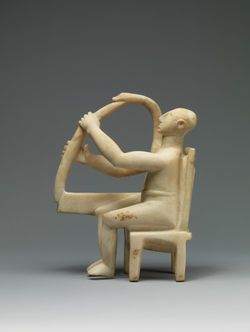
There are three figurines here for you to analyze: two female figurines, and one male figurine.
Female #1: 2700-2600 BCE. Height: 14 1/2 inches. Findspot: somewhere in the Cycladic islands.
You can find even higher-resolution photos on the museum's website: http://www.metmuseum.org/art/collection/search/253423
Female #2: 2300-2200 BCE. Height: 10 3/4 inches. Findspot: somewhere in the Cycladic islands.
You can find even higher resolution photos on the museum's website: http://www.metmuseum.org/art/collection/search/255595
Male #1: 2800-2700 BCE. Height: 11 1/2 inches. Findspot: somewhere in the Cycladic islands.
You can find even higher resolution photos on the museum's website: http://www.metmuseum.org/art/collection/search/254587
First, take a minute or two to look closely at the images above. Write down your reaction to these objects--what did you think about when you first saw them? What parts of these objects caught your eye? Why did you pick these objects for your response paper? Make notes on things that you notice about them. Also, write down any questions you have about them--what kinds of things would you want to know about these objects? Remember the questions we ask in class. You don't need to have answers for these questions yet, but keep them in your notes.
Once you have some questions written down, try to answer them by reading the information I've provided below about these objects and their context.
Context: Where Were They Found, And What Do We Know?
The Cycladic islands are a collection of about 2000 islands in the Aegean Sea off the coast of Greece. Many of the islands have abundant natural deposits of marble. The people of the Cycladic islands lived in small communities on these islands, and depended heavily on the sea for their livelihoods.
The statuettes above were likely carved using stone tools, made of a particularly hard local stone called emery. Emery powder would have been used to polish the marble by rubbing it over the surface. The creation of a Cycladic figurine was based on strict rules and a detailed system of proportions, which required precise measurements and considerable skill in application. Therefore, it was most likely the work of specialized craftsmen.
While the statuettes above look like plain marble figures, they were originally painted in bright colors. Archaeologists can use techniques such as chemical analysis or UV-photography to spot the traces of paint. Red and blue are the most common colors used in Cycladic art. Green and black are also used, but less frequently. All colors were produced from minerals:
- red from iron oxides (hematite), red ochre or cinnabar (mercury sulfide); the latter material is not native in the Aegean and was probably imported from Asia Minor or the Balkans;
- blue from azurite (copper carbonate);
- green from malachite or hydroxide of azurite;
- black was probably produced by oxidization of another mineral, possibly azurite.
The use of color on figurines is not always easy to attest. In some cases, there are clearly visible remains on the marble. More often, however, the only trace is a “paint ghost”, i.e. a smoother part of the surface or the outline of a painted feature (e.g. an eye, a tiara) that looks as if it has been rendered in low relief: in fact, the pigment applied in those areas protected the marble surface from the erosion suffered by the rest of the figurine and appears today smooth, lighter in color and slightly raised in comparison to the uncolored areas. You can see an example of this on the first figurine--look closely at the face. Black and blue were normally used to define or emphasize anatomical details of the head and body, such as the eyes, eyebrows, hair and pubic triangle. Red was used to emphasize incised details and depict ornaments (necklaces, bracelets), power or status attributes (tiaras, headbands) and various decorative motifs on the face and body. The ears, mouth and nostrils were usually not painted.
Since the Cycladic people had no writing system, any interpretation of these figurines has to be based exclusively upon archaeological finds and reasonable assumptions. Unfortunately, the majority of these figurines were looted, and thus all information about their context has been lost. Of the figurines that have been found in archaeological excavations, most of them so far have been found in graves. However, the figurines may have been used in religious contexts (shrines or temples)--very few of these have been discovered by archaeologists and carefully/scientifically excavated.
The male figure is rarely represented in Cycladic art. Most frequently it appears in the form of a seated figurine, a musician, or a hunter/warrior. The female figure is usually represented as above: nude, with an emphasis on the breasts and pubic area. This has led to many interpretations of these figurines which emphasize fertility--but then, what are they doing in graves? What does fertility have to do with funerals? And what about the figures that are almost life-size, such as the one we looked at in class? Those figurines are too large to be placed in a grave. Note also that these figures--even the really big ones--are not carved to stand up on their own. Their feet are not flat on the ground. What is the paint for--why bother painting the figures? What meaning does that have?
Some things to consider in your response paper:
-
What was your response to these objects? What drew your eye? You are encouraged to use first person (I/me) in your response paper. I want to know what you think.
-
Try to imagine the artists sculpting these figurines; put yourself into his or her mind. What kinds of decisions did the artist make when they were creating this piece, and why did they make those choices? Think about the human body, and how it is being represented here
-
While these figurines aren't large, an artist still put time and effort into creating them; the artist had a reason for doing this, ideas or concepts or beliefs they wanted to express. What do you think the artist might have been trying to express here? Do you think we can draw any conclusions about how the Cycladic peoples thought about gender, based on these figurines? Consider also that the majority of these figurines are found in tombs. What does that tell you about the meaning of the figurines?
-
Be a little imaginative--how do you imagine the Cycladic people interacting with these figurines? In a temple? During a funeral? In their house? Use the information above to help construct your interpretation.
-
Note that female figure #2 is missing her head. The rough-looking texture at the top of her neck is from a repair attempt--probably done about 1000 years after the figurine was made. What does that tell you about the figurine and its owner?