"Images seem to speak to the eye, but they are really addressed to the mind.
They are ways of thinking, in the guise of ways of seeing."
--William Duff
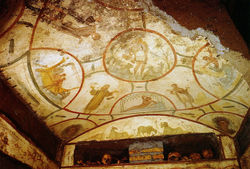
Christian Catacomb, Painted Ceiling
4th century CE
 |  |  |
|---|---|---|
 | 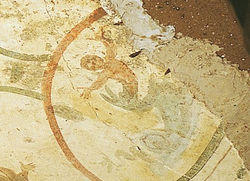 |  |
First, take a minute or two to look closely at the images above. Write down your reaction to this object--what details do you notice? Why did you pick this painting for your response paper? Make notes on things that you notice about it. Also, write down any questions you have about it--what kinds of things would you want to know about this painting? Remember the questions we ask in class. You don't need to have answers for these questions yet, but keep them in your notes.
Once you have some questions written down, try to answer them by reading the information I've provided below about this object and its context.
What do we know about this site and these paintings?
The catacombs of SS. Pietro and Marcellino, where this fresco is located, are located near Rome (about 3km southeast of the city). The pagan Romans had a tradition of burying their dead outside the city walls, and even after many inhabitants converted to Christianity, they continued to follow this practice (rather than burying their dead in a churchyard). The catacombs are large, with three levels and 4.5km of corridors. Excavations between 2004-2010 identified the remains of 20,000 people in the catacombs.
The catacomb is named after two martyrs, St. Peter the Exorcist and St. Marcellinus, who were buried here in the early 4th century CE. We know very little about their lives. They were supposedly killed during a crackdown on Christians in 304 CE.
The catacomb is decorated with paintings that mix Christian and pagan imagery. The fresco above adorns a ceiling--you can see a couple of skeletons in niches below the ceiling. I don't have exact dimensions for this room, but it is large enough to stand up in and move around. The catacomb was constructed in the 4th century, perhaps during the time of Constantine when Christianity became more legal and public. Constantine himself built a basilica (located elsewhere in Rome) in honor of the two saints.
Look closely at the imagery. You will notice the Good Shepherd (Jesus), several praying figures (remember the praying woman on the sarcophagus from class) as well as several episodes in the life of Jonah. According to the Bible, Jonah was a Christian who was ordered by God to go to the city of Nineveh (in modern-day Iraq) and preach to the people of Nineveh, in hopes of showing them how wicked they were. Jonah refuses this task and tries to run away. He is a passenger on a ship when a sudden storm blows up, which threatens to wreck the ship. The sailors throw cargo into the sea to lighten the ship's load and prevent it from capsizing. The sailors become convinced that this storm is sent by some deity, and they cast lots (a divination technique) to see which deity is responsible. Eventually they become convinced that Jonah's God is causing the storm. When the sailors confront Jonah, he admits that this is probably true, because he tried to run away from the task God had given him. The sailors ask what they should do, and Jonah tells them to throw him into the sea, so that the sailors will be safe from the storm. They do so, and Jonah is then swallowed by a huge fish. Jonah remains trapped in the fish's belly for three days and three nights, but after a particularly heartfelt prayer to God, God commands the fish to vomit Jonah onto the shore. Jonah then follows God's command and goes to Nineveh. He preaches that Nineveh will be destroyed by God in 40 days if they do not repent, and the people of Nineveh believe him and begin fasting, dressing humbly, praying, and otherwise trying to change their behavior and earn God's favor. God was pleased at their change of heart and decided not to destroy them. Jonah, however, was angry at God for sparing the people of Nineveh. He left the city and made himself a shelter in a spot overlooking the city, and waited to see what would happen to the city. God provided a leafy plant which grew up over Jonah's head and provided shade, which Jonah appreciated. However, at dawn the next day, God provided a worm which chewed the plant and caused it to wither in the heat of the day; Jonah was upset that his shade had disappeared, and became angry with God. God then compares the plant to the city of Nineveh, which God cares about just as Jonah cared about the plant.
Jonah is a common subject in early Christian art. There are several interpretations trying to explain why this is. One suggestion is that Jonah's three days in the fish's belly, from which he emerges alive, are equivalent to the three days Jesus' body spends in the tomb, from which he also emerges alive. In the Gospel of Matthew, Jesus is asked for a sign, and says the sign will be the "sign of Jonah", foreshadowing his resurrection. The themes of death and resurrection are quite common in early Christian imagery connected with tombs and death (such as the sarcophagus we examined in class). Another suggestion is that the story of Jonah proves God's mercy, an idea which may have been particularly important in a catacomb, a home for the dead (who surely hope for God's mercy in the afterlife). In Judaism, the story of Jonah is taken as an example of the ability to repent and be forgiven by God.
Some things to consider in your response paper:
-
What was your response to this painting? What drew your eye? You are encouraged to use first person (I/me) in your response paper. I want to know what you think.
-
Consider the details of the painting carefully, noting each panel or section. What kinds of decisions did the artist make when they were painting this ceiling, and why did the artist make those choices? Use your art terminology. Think about where the artist placed each scene, in relation to the other scenes. What kinds of connections or relationships are created between the different images/stories? I notice, for example, that the images from Jonah's story are not in chronological order around the ceiling.
-
Compare the images in this painting to the images we looked at in class--many of these subjects (the Good Shepherd, the praying devotee, the elements of Jonah's story) come up frequently in early Christian art. Why do you think the artist here combined these images in this way--what kind of message(s) was the artist trying to send? Who do you think is the "audience" for these images?
-
Think also about the context of these images, in a place of burial. It's interesting that funerary contexts are the most common place we find early Christian art. More than decorative niceties, these paintings were articulations of Christian theology—a visual expression of what these believers thought about death. The paintings were meant to be seen by visitors to the catacombs. They served as confessions of faith and symbols of hope for the community after one of its own died. What do these paintings say about early Christian belief, and the things that were important to early Christians?