"Images seem to speak to the eye, but they are really addressed to the mind.
They are ways of thinking, in the guise of ways of seeing."
--William Duff
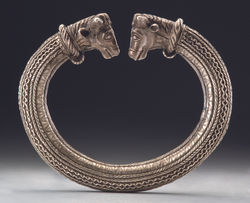
Trichtingen Torc
350 - 100 BCE
 |  |
|---|
Material: silver wrapped around an iron core
Size: 11.5 in diameter, weighs more than 13 lbs
First, take a minute or two to look closely at the images above. Write down your reaction to this object--what details do you notice? Why did you pick this object for your response paper? Make notes on things that you notice about it. Also, write down any questions you have about it--what kinds of things would you want to know about this object? Remember the questions we ask in class. You don't need to have answers for these questions yet, but keep them in your notes.
Once you have some questions written down, try to answer them by reading the information I've provided below about this object and its context.
What do we know about this object?
In class we examined a gold torc necklace, and also saw the Cernunnos figure on the Gundestrup cauldron wearing a torc and holding one. It is clear that this was an important type of object in Celtic culture. Keep these parallels in mind as you look at this object.
This torc was found by chance in a field during construction work in southwest Germany near Trichtingen. It is made of silver, but has an iron core. We don't really know anything more about its findspot; it doesn't seem to have been part of a burial. Celtic peoples would sometimes give valuable gifts to the gods by burying them in a bog (think of the famous bog bodies), or this could have been dropped/lost.
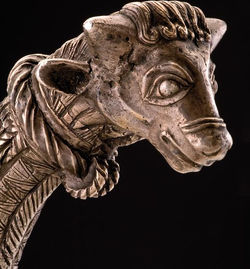
As we saw in class, torcs were important status symbols, and could be very elaborate (like this one). Note that the animals--probably bulls--in this piece are also wearing their own small torcs. Torcs were often worn, and would simply be bent open, placed around the neck, and bent back into shape. However, the fact that this one is not hollow would make it pretty much impossible to bend open. A few torcs were built with hinges at the back, but this one clearly does not have any kind of a hinge.
Just like with the Gundestrup cauldron we looked at in class, this object may show influence from the region of Thrace (modern Romania). Silver objects are relatively rare in the Celtic world, and Thrace was an area that had a lot of expertise in working silver. The torc itself is neverthless a uniquely Celtic type of object.
Some things to consider in your response paper:
-
What was your response to this object? What drew your eye? You are encouraged to use first person (I/me) in your response paper. I want to know what you think.
-
Consider the details of this object carefully. What kinds of decisions did the artist make when they were creating this piece (about line, texture, or composition), and why do you think they made these choices? Use your art terminology.
-
What kind of story do you think this object can tell? Who might have owned it? Obviously we can't put a name to the owner, but we can speculate about the kind of person who might have owned this. In particular, you might consider this as a symbol of status. What are some of the ways this object communicates status? How do you think this object might have been used, if at all, before it was buried? Why did it end up in a field in southwest Germany?