"Images seem to speak to the eye, but they are really addressed to the mind.
They are ways of thinking, in the guise of ways of seeing."
--William Duff
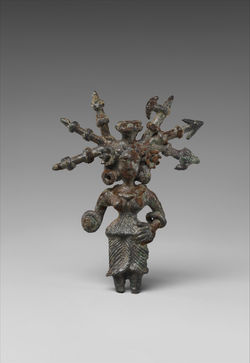
Goddess Figurine
2nd - 1st century BCE
 |
|---|
Material: bronze
Size: 3 in. tall
First, take a minute or two to look closely at the images above. Write down your reaction to this object--what details do you notice? Why did you pick this object for your response paper? Make notes on things that you notice about it. Also, write down any questions you have about it--what kinds of things would you want to know about this object? Remember the questions we ask in class. You don't need to have answers for these questions yet, but keep them in your notes.
Once you have some questions written down, try to answer them by reading the information I've provided below about this object and its context.
What do we know about this object?
This is a small cast bronze figurine. The craftsperson would have produced a mold using clay, with space in the middle for the molten bronze. Then the craftsperson would have poured the molten bronze into the mold. After the bronze cooled and hardened, the craftsperson would have broken the mold open and polished the figurine.
On the Metropolitan Museum of Art's website, this figurine is called the "Goddess with Weapons in her Hair". It was donated to the museum by an art collector. In order to discover more information about the figurine, the museum curators looked for similar objects--arguing that this object might have been produced in the same place or at the same time as similar figurines. Using this logic, the statuette above was probably produced in the 2nd-1st century BCE in Pataliputra (modern Patna). This is a city with a long history. According to Buddhist legends, the Buddha passed through here during his last year of life. From 321-185 BCE, the Mauryan dynasty ruled over northern India, and Pataliputra was its capital--the nerve center of a large and prosperous empire. After the Mauryan empire collapsed, smaller kingdoms ruled over India until a new dynasty arose several centuries later. Patna continues to be an important city all the way up to the present day in India.
The title "Goddess with Weapons in her Hair" might remind you of the goddess Durga--we looked at a statue of her in class. The imagery of Durga, the goddess bristling with weapons who defeated the buffalo demon, doesn't actually develop until about the 5th century CE, several hundred years after this little figurine was made. In this figurine, however, we may see the beginnings of Durga, and certainly we see the idea of a goddess with awe-inspiring strength and weaponry who can protect her people.
Some things to consider in your response paper:
-
What was your response to this object? What drew your eye? You are encouraged to use first person (I/me) in your response paper. I want to know what you think.
-
Consider the artistic details of this object carefully. What kinds of decisions did the artist make when they were creating this piece, and why? Use your art terminology.
-
The figurine shows a woman, generally interpreted as a goddess. Consider the examples of art we looked at in class inspired by the religion of Hinduism. What visual clues tell you that this is probably a "goddess" and not just an ordinary person?
-
This is a small figurine, just three inches tall. What does that size suggest about how this figurine might have been used, or who might have owned it? Who do you think might have owned this figurine, and why might someone have been drawn to this goddess? What about her might be appealing to a worshiper? What do you think this figurine might have meant to its owner?