"Images seem to speak to the eye, but they are really addressed to the mind.
They are ways of thinking, in the guise of ways of seeing."
--William Duff
Ibex Spearthrower
16,000 - 12,000 years old
 |
|---|
 |
 |
 |
 |
Material: deer antler
Size: 4.4" high, 1/7" wide
I intended to look at a couple of spearthrowers in class--you can see them in the powerpoint and compare them with this one. Spearthrowers were important tools for hunting, because they gave the hunter greater power and accuracy behind his throw. Here is an example of a person carving a spearthrower out of wood and using it: Video
The hook at the top of the spearthrower above is where the spear butt would rest. Actually, in this case, it was probably more like a dart--note that this object is only 4.4 inches tall.
First, take a minute or two to look closely at the spearthrower in the images above. Write down your reaction to it--what did you think about when you first saw this? What parts of this artwork caught your eye? Why did you pick this object for your response paper? Make notes on things that you notice about it. Also, write down any questions you have about it--what kinds of things would you want to know about this object? Remember the questions we ask in class. You don't need to have answers for these questions yet, but keep them in your notes.
For even higher-resolution photos, try these links:
Once you have some questions written down, try to answer them by reading the information I've provided below about the spearthrower and its context.
Context: Where was it found?
This spearthrower was found in the Mas d'Azil cave in France. Archaeologists have discovered evidence that this cave was inhabited by people for about 20,000 years, from about 30,000-10,000 years ago.
In these caves, archaeologists also found:
-
Other spearthrowers carved with images of deer, ibexes, horses, and birds (including one of the spearthrowers with the female deer either pooping or giving birth, which we looked at in class--about 10 total copies of this spearthrower design have been found in different places, so it must have been popular!)
-
Other images, either carved or painted, showing bison, aurochs (large wild cattle, now extinct), horses (wild--we're still several thousand years before the domestication of the horse), and fish. There are also a couple of female figurines, a sculpted phallus, and a small disk carved with a scene of a man hunting a bear (on the reverse side, the bear is striking the man).
-
Hunting tools such as small harpoons (perhaps for catching fish), tools for scraping and tanning leather, sewing needles, and many stone blades and tools of different sizes.
-
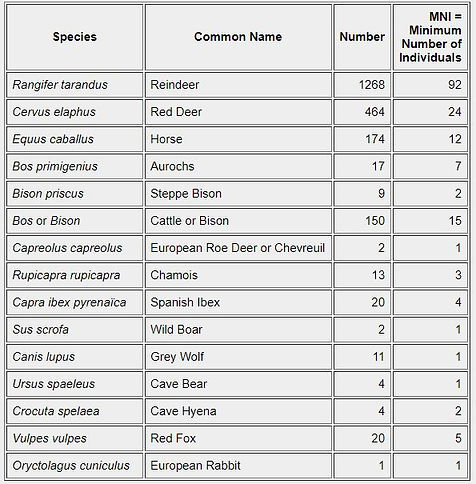
Many animal bones, showing which animals these people hunted and consumed:
Note: In the table above, "number" refers to the total number of bones from that species. There may be multiple bones from the same animal, so this is not necessarily representative of the total number of animals slaughtered or used by the people living in these caves. "Minimum Number of Individuals" provides this information--based on the bones found, what is the minimum number of animals those bones could have belonged to? For example, if an archaeologist is excavating and finds five cow bones, including two skulls, the MNI would be 2--because one animal cannot possibly have two skulls, so there must have been at least two separate animals.
What Do We Know?
The name I have given this object is the "ibex spearthrower". An ibex is a type of wild goat that tends to live in mountainous locations. See more about the animals here. If you don't know what this animal looks like, follow the link and look at the images, and then look at the spearthrower again. Do you see the animal?
Some Things To Consider For Your Response Paper:
1. What was your response to this piece of art? What drew your eye? You are encouraged to use first person (I/me) in your response paper. I want to know what you think.
2. Think about this object as a useful tool--how was it used? How were these spearthrowers designed to be as useful as possible to hunters? How important was hunting in the lives of the people who lived in these caves? Consider the other kinds of objects found in the caves (listed above). What kinds of activities were being carried out here? What do you think it would have been like to live in this cave at this time?
3. There are two animals which are relevant to this object. The spearthrower is made of deer antler, and it shows an image of an ibex. Consider the chart above, which shows the number of animal bones found in the caves at Mas d'Azil. How important were these two animals in the lives of the people who lived in these caves?
4. Think about this object as an artwork--try to put yourself into the mind of the artist. What kinds of choices has the artist made? What makes this such a beautiful or eye-catching piece of art? Also, why do you think the artist chose to show an ibex on this spearthrower? In the information about the cave listed above, I included a list of animals depicted on spearthrowers found in these caves. Is there anything these animals have in common?