"Images seem to speak to the eye, but they are really addressed to the mind.
They are ways of thinking, in the guise of ways of seeing."
--William Duff
Cylinder Seals
3000-2200 BCE
 |  |  |
|---|---|---|
 |  |
First, take a minute or two to look closely at the seals and their impressions in the images above. Write down your reaction to these images--what did you think about when you first saw this? What parts of these artworks caught your eye? Why did you pick these seals for your response paper? Make notes on things that you notice about them. Also, write down any questions you have about them--what kinds of things would you want to know about these seals? Remember the questions we ask in class. You don't need to have answers for these questions yet, but keep them in your notes.
Once you have some questions written down, try to answer them by reading the information I've provided below about the seals and their contexts.
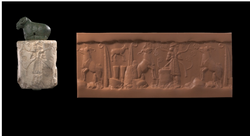
Seal #1 (Images 1, 2, & 3 all show this seal):
This seal was produced around 3000 BCE. We don't know where it was found (which is a pretty good indication that it was looted, or that the archaeologist who dug it up didn't keep any records about it). Because it lacks context, the seal is dated very approximately based on comparing its style to other seals.
The seal is carved out of marble, with a bronze ram (male sheep) inserted on top. This would have made it easier to handle when you were pressing it into clay to make an impression.
You also see what it looks like when this seal is rolled onto wet clay. Look carefully at this scene--there are some elements you may recognize from our in-class discussions. I would also encourage you to take a quick look at the Warka Vase, also in the Middle East gallery, and see if you spot a similar pair of objects here.
Seal #2 (Image 4):
This seal was produced between 2600-2400 BCE in the city-state of Ur. If you did your readings for this class, you watched a video about the Standard of Ur, which was found in one of the Royal Tombs of Ur. This seal was also found in one of the Royal Tombs (though not necessarily the same tomb). I tell you this, because it might hint at the identity of the owner. At this time, Ur was one of the wealthiest and most powerful city-states in Mesopotamia--a center of trade, commerce, and culture. Also by this period, as you can tell by the fact that there are royal tombs, these city-states were being ruled by kings who lived in palaces (instead of priests in temple complexes like we saw in earlier periods).
The material of this cylinder seal is lapis lazuli. We talked about this stone briefly in relation to both the Middle East and Egypt--at this period of history, the only place you could get this stone was from some mines in what is today Afghanistan. That's hundreds of miles away from the city of Ur. The owner of this cylinder seal could presumably have chosen a seal made of any material they wanted (and could afford); why do you think they might have chosen a seal of lapis lazuli?
Next to the seal, you can see the impression of the design. Look closely at this design, because it is quite odd and foreign to our modern eyes. Think about some of the objects we looked at in class--especially the silver cup we looked at right at the end of class. We talked about some of the myths that were popular in Mesopotamia, which sometimes described heroes who killed dangerous or mythological animals in their adventures.
Seal #3 (Image 5):
This seal was created about 2200 BCE in the city-state of Ur. Like seal #2, this was found in one of the Royal Tombs--but in this case, we actually have a name that we can put to this cylinder seal. The owner of this seal, identified by a tiny cuneiform inscription which you can see in the upper left corner, is named Pu-Abi. Historians generally think she was a queen of Ur. She was buried with an astonishing quantity of very rich ornaments and objects. Because her name is given without any title like "queen" or "wife of _____", some historians have suggested that Pu-Abi might not have had a husband, or at least she might have ruled in her own right as Queen rather than being subservient to a male king. It's hard to be sure--but she was certainly wealthy!
Consider the scene that was carved onto this seal. What are the figures doing? What is happening in this scene? Or, do you think this is actually a series of scenes showing different moments? Do you think any of the figures here might represent Pu-Abi herself?
This seal is also made out of lapis lazuli, like seal #2. Pu-Abi was also buried with other jewelry and objects made of imported gemstones like lapis lazuli and carnelian, as well as lots of gold. Below is a reconstruction of her headdress and jewelry. Look at those earrings! Pretty choker, too, isn't it? I'd wear that.

Some things to consider in your response paper:
-
Make sure to discuss all three seals in your paper. I included three because I thought it would be interesting to compare them and think about the different individuals who might have owned them.
-
What was your response to these pieces of art? What drew your eye? You are encouraged to use first person (I/me) in your response paper. I want to know what you think.
-
Consider the design of these seals carefully. Try to imagine the artist creating each one, carving it from stone. How did the artist make use of line, texture, or scale to show certain details of the scene he/she was creating? Try to put yourself in the mind of the artist.
-
Some of this imagery is mythological or symbolic, while some might represent actual scenes from life. How do you interpret each of the scenes on these three seals? The artist deliberately added each detail (and think about how small these are! There's not much space here--every detail must be important). What kind of "story" or idea were the artists trying to convey with each seal?
-
Remember what these objects were used for. Individuals kept a seal to impress on clay tablets (like a modern-day signature), usually for official government or business purposes. For example, if two parties were entering into a contract, archaeologists will often find the text of the contract on a clay tablet, and then on the back there will be the seal impressions of the witnesses. Each seal impression was therefore (at least theoretically) unique, just like a signature. We might imagine that the owners ordered these seals and requested particular imagery; even if they were choosing from an available selection, the act of choosing is in its own way an act of self-expression. Why do you think a person might have chosen each of these seals for their personal "signature"?
-
Connect the imagery to material from class or from the readings wherever you can--there are several connections you can make. Also, make sure to bring in the historical details I provided above wherever they are relevant to your interpretations.