"Images seem to speak to the eye, but they are really addressed to the mind.
They are ways of thinking, in the guise of ways of seeing."
--William Duff
Tomb Models
1981 - 1975 BCE
 |  |  |
|---|---|---|
 |  |  |
 |  |  |
 |  |
Material: plastered and painted wood, gesso
Size: 28.5in. long, 22.5in. wide, 11in. high (the dimensions are for the first model, but the other two are similarly sized)
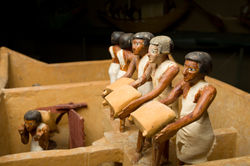
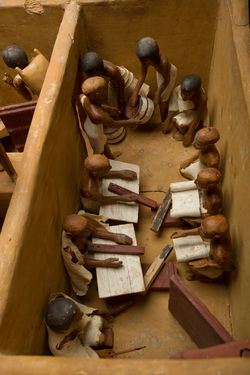
I have provided you with images of three models:
-
Images 1-4 show Model #1
-
Images 5-6 show Model #2
-
Images 7-11 show Model #3 (and some of the individual figures from this model)
First, take a minute or two to look closely at each of these objects. Write down your reaction to these models--what did you think about when you first saw them? What parts of these models caught your eye? Why did you pick these objects for your response paper? Make notes on things that you notice about them. Also, write down any questions you have about them--what kinds of things would you want to know about these objects? Remember the questions we ask in class. You don't need to have answers for these questions yet, but keep them in your notes.
Once you have some questions written down, try to answer them by reading the information I've provided below about these objects and their context.
Context: Where Was It Found?
These models were found in the hidden side chamber of a tomb which belonged to a man named Meketre. Based on the inscriptions in the tomb, Meketre was the royal chief steward. A steward is an official who manages or looks after another person's property--in this case, the property of the pharaoh, who owned many estates, farms, and workshops. Meketre served several pharaohs. He started his career under Mentuhotep II, and continued to serve Mentuhotep III and IV, and then died during the reign of Amenemhat I.
By the time Meketre's tomb was discovered by archaeologists, all the main rooms had been looted. The chief archaeologist wanted an accurate map of the tomb, so he had his workmen clean out all the debris, and in the process they found this hidden chamber which had not been looted. It contained 24 of these models.
Why was Meketre buried with all these models? Remember our discussion in class about Egyptian attitudes toward the afterlife. For Egyptians, the afterlife was kind of a continuation of our present lives--one still required food, clothing, and other necessities in the afterlife. And of course, someone had to produce those necessities, even in the afterlife. The Egyptians believed that all the things you were buried with would come with you to the afterlife, where you could make use of them. Human figurines like these were believed to come to life and work for you in the afterlife. Look closely at the details of each model. What do you think the people are doing in models #1 and #3? Why would Meketre want a model like #2 in his tomb?
What kinds of details do these models tell you about life in ancient Egypt? How do you think Meketre's job as the royal chief steward, a job which he did faithfully for many decades, might have influenced the design of these models (and Meketre's choice to include them in his tomb)?
Some things to consider in your response paper:
-
What was your response to these objects? What drew your eye? You are encouraged to use first person (I/me) in your response paper. I want to know what you think.
-
Consider these models carefully. Try to imagine the artist carving each figure out of wood, painting them, and carefully placing them in the model. What kinds of decisions did the artist make, and why? Use your art terminology. Try to put yourself in the mind of the artist.
-
What kinds of details do these models tell you about life in ancient Egypt? Discuss all three models in your answer. I want to see that you really looked closely at the details here, because the details are important (if these figures are going to come to life in the afterlife, then they ought to be pretty lifelike, right?).
-
Why do you think Meketre had these three models placed in his tomb? What does this tell you about his belief system? Bring in details about the Egyptian view of the afterlife to explain these models and their presence in the tomb. How do you think Meketre's job as the royal chief steward, a job which he did faithfully for many decades, might have influenced the design of these models (and Meketre's choice to include them in his tomb)?