"Images seem to speak to the eye, but they are really addressed to the mind.
They are ways of thinking, in the guise of ways of seeing."
--William Duff
Ajax Amphora
around 530 BCE
Trigger Warning: suicide
 |  |  |
|---|---|---|
 |  |
Material: clay and slip (paint made of clay + water)
Size: 1 1/2 feet high
I have provided you with the following images:
-
Images 1-3: Side A of this vase
-
Image 4: Side B of the same vase
-
Image 5: A scene from another vase by the same artist, which shows a similar scene (maybe) to Image #4--see below
First, take a minute or two to look closely at the images above. Write down your reaction to this object--what did you think about when you first saw this? What parts of this object caught your eye? Why did you pick this object for your response paper? Make notes on things that you notice about it. Also, write down any questions you have about it--what kinds of things would you want to know about this object? Remember the questions we ask in class. You don't need to have answers for these questions yet, but keep them in your notes.
Once you have some questions written down, try to answer them by reading the information I've provided below about this object and its context.
Context: What Do We Know?
We don't know much about the context of this vase. It was produced in Athens--the type of clay used, and the style of the painting, matches vases produced in Athens. As part of your readings, I provided a video about the production of these vases, and the three-part firing process they went through to produce the black figures. After firing, details were etched onto the surface using a sharp tool. The artist in this case is a man named Exekias. Many examples of his work survive, including some where he signed his name. Although this vase does not have his signature, the style of the painting matches the style seen on other Exekias vases.
Today this vase is in a museum in France. Although the museum provides little information about where this object was found, the majority of Greek pottery (especially intact pieces like this one) have been found outside of Greece, in Italy. A people called the Etruscans bought large amounts of Greek-made pottery and put these vases in their tombs. In the 1800s, Europeans discovered the beauty of these vases and their value increased; as their value increased, tomb robbers looted more and more of them.
The vase has two sides. The image on Side A is extremely rare in Athenian vase painting. The Greek hero Ajax is preparing to commit suicide. This story is told in a famous play by Sophocles, titled Ajax. It is the tenth year of the Trojan War. The hero Achilles has been killed by Paris (possibly helped by the god Apollo). Ajax carried the body of Achilles off the battlefield. Achilles was buried, and his armor was to be given to the best warrior among the Greeks. It came down to two warriors: Odysseus and Ajax. Both gave a speech arguing why he ought to be given the armor of Achilles. Ajax is a great warrior, a strong and skilled fighter--but he is not good with words. Odysseus makes a better case, and he is given the armor. Ajax feels disrespected, and feels that the army (which made the decision) did not value the many years of service he gave, fighting on the front lines, protecting the men with his massive shield. He is ashamed to have lost this contest. He gets so angry with the commanders of the Greek army (Agamemnon and Menelaus) that he decides to murder them in the night, to recover his honor as a warrior. The goddess Athena, who supports the Greek cause, alters Ajax's mind so that instead he murders a herd of cattle. When Ajax regains his mind, he is in his tent, surrounded by blood and gore, torturing a poor animal. He is so ashamed of himself that he does not feel he can continue, and instead he goes out by the seashore, buries his sword in the earth to hold it steady, and then falls on it. His wife Tecmessa finds him there, and the play ends with an argument over the body of Ajax. Agamemnon feels the body should be left unburied, which would have been a terrible dishonor; but Odysseus shows up and argues that the body should be buried, and that one shameful act does not negate all the other honorable acts a person has done in their life. Ajax is buried on the shores of Troy, and he never returns home to his parents and his homeland. On this vase, Exekias chooses to show the moment before the suicide. Other vase painters occasionally show the scene after Ajax's suicide, when his wife discovers his body, but Exekias is the only one to show the moment before the suicide. Ajax has stripped off his armor, and he has buried the sword in the earth. He is alone, about to fall on his sword.
In an interesting example of the power of storytelling, the play Ajax has been performed many times (organized by a professor, Brian Doerries) for an audience of modern veterans. These veterans find that a lot of their struggles, PTSD, and emotions are expressed astonishingly well by the playwright Sophocles, even though he was an ancient Greek from 2500 years ago. Many of these modern veterans identify strongly with Ajax and what he goes through in this play.
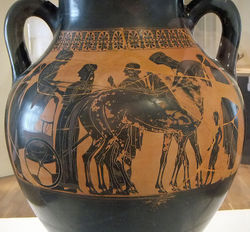
Side B of the vase shows a rather generic scene--it's impossible to assign names to any of these figures. Two men stand in a chariot (an old-fashioned type of transportation no longer used by the time this vase was made). Behind the chariot stands a man, and in front are a woman and a man. In front of the horses, there is a small figure which is probably a slave (lesser status, or perhaps a boy) and another man. The style of painting is less sophisticated, and it is possible Exekias allowed one of his less skilled colleagues to paint this side of the vase.
In Image #5, I have provided you with a photograph of another vase by Exekias, with a somewhat similar scene to Side B. In this image, two young men (Castor and Pollux) are returning home to their parents (the woman on the left, and the older man holding the horses' heads). On the right, a slave boy comes forward with a stool, clothes, and a small jug of oil so that the young men can bathe and change after their travels. You are perfectly welcome to disagree with me, but I suggest this scene as a possible image which can be compared to, and may help us understand, Side B of the Ajax vase. Perhaps Side B shows a homecoming--or a departure scene?
As we did in class with the Sarpedon vase, compare both sides. Think about why these two scenes have been placed on this vase. First there is the scene of Ajax's suicide, which is very rare in Greek art--why show this? Second, there is side B. What is the story being told in this scene, in your opinion? Can you connect it to the scene on Side A?
Some things to consider in your response paper:
-
What was your response to this object? What drew your eye? You are encouraged to use first person (I/me) in your response paper. I want to know what you think.
-
Consider each scene on the vase carefully. Try to imagine the artist painting this piece; put yourself into his or her mind. What kinds of decisions did the artist make (about lines, composition, the choice of subject, etc.) when they were creating this piece, and why did they make those choices? By "composition" I mean choices about where certain figures or objects in the painting should be placed, relative to other figures. Consider each side separately before you try to interpret them together.
-
How should we interpret this piece of art? What kind of message(s) does it send about Ajax, Greek mythology, or the human experience in general? Why do you think these artists chose to put these two scenes on this vase? Put together, do these two scenes tell a complete story? Or are the two scenes "opposites" which contrast in some way and reveal some insight about the subjects of these paintings?
-
An amphora was a type of vase generally used for storage of food or liquids in the home. However, a nice painted vase like this is hardly likely to have been used in the kitchen! Presumably this vase was meant to be used or displayed in the more public parts of the home, for example during a symposium party (male-only). Consider the audience of this vase--who was meant to see it? What lessons, emotions, or ideas were they supposed to infer from the paintings on this vase?