"Images seem to speak to the eye, but they are really addressed to the mind.
They are ways of thinking, in the guise of ways of seeing."
--William Duff
Roman Portraits Over Time
1st century BCE - 4th century CE
 |  |  |
|---|---|---|
 |  |  |
I have given you images of several portraits, most of them depicting emperors:
-
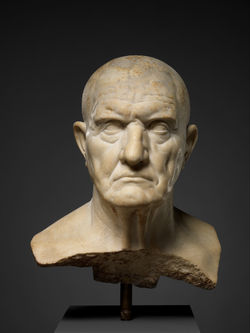
Image #1: A portrait of a Roman man in the Veristic style--similar to the portrait head we examined in class. Life-size.
-
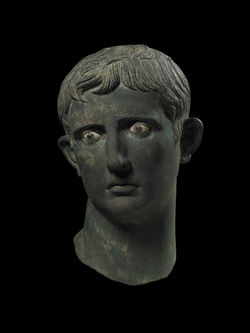
Image #2: A bronze portrait of the Emperor Augustus. Created between 31-25 BCE. 18 inches high--probably came from a larger-than-life statue. The flesh is bronze, and the eyes are made of glass (pupil) and white calcite (iris).
-
Images #3-4: A marble portrait of the Emperor Hadrian, produced between 125-130 CE. 32 inches tall.
-
Image #5: A marble portrait of the Emperor Caracalla, produced during his brief rule between 212-217 CE. 14 in. tall.
-
Image #6: A marble portrait of the Emperor Constantine, produced sometime between 325-370 CE. This head is 3 ft. tall, and weighs 1100 lbs. It was originally part of a much larger than life size statue.
First, take a minute or two to look closely at the images above. Write down your reaction to each object--what details do you notice? Why did you pick these portraits for your response paper? Make notes on things that you notice about them. Also, write down any questions you have about them--what kinds of things would you want to know about these objects? Remember the questions we ask in class. You don't need to have answers for these questions yet, but keep them in your notes.
My intent with this selection of portraits was to get you thinking about the way the representation of the emperor changed over several hundred years. This reflects changing values in society, as well as the personality of the emperors themselves and their style of rule.
Once you have some questions written down, try to answer them by reading the information I've provided below about this object and its context.
Context: What Do We Know?
Consider that portraits are a form of self-presentation. The portraits you see here represent the way these individuals wanted to be seen--by their fellow citizens and/or their subjects. What does each portrait say about the person who is represented?
Bust #1: This was produced in the early 1st century CE, during the early period of the emperors. The style is like the late Republic portrait head we examined in class, however. This man--whoever he was--wanted his portrait to reflect those earlier ideals, even though in the 1st century CE the ideals of the Republic were being replaced by the new political reality of the Empire. What do you think that says about the person who had this carved? What values were they trying to express, and what might they have thought about the new Imperial politics?
Bust #2: This is a portrait of the emperor Augustus. Augustus (who began life under the name Octavian) became an important and powerful politician in the 40s BCE, and after the death of his adopted father Julius Caesar, Octavian waged a civil war to destroy Caesar's murderers. By the time the war was done, Octavian and his ally Mark Antony were the two most powerful men in Rome. They split the empire between them; Octavian took the west, including Rome, and Mark Antony ruled over the east, where he met and married Cleopatra. Relations between the two men rapidly devolved into civil war. Octavian defeated Mark Antony and Cleopatra at the Battle of Actium in 31 BCE. This victory had a couple of major results. Octavian was the last man standing, and since there was no one to challenge his power, he gradually created a position for himself as Emperor of Rome. Also, Egypt no longer had a ruler (Cleopatra committed suicide) and so Octavian annexed Egypt into the Roman empire. Octavian--who took the title Augustus after he became emperor--then had portraits of himself installed in Egypt, to announce to the people who their new ruler was. Keep in mind that most people would never have seen the emperor in person, so this was the only image that they knew. By the time this image was made, Augustus (who was born in 63 BCE) was somewhere between 35-40 years old. Does that look like a portrait of a 35-40 year old man? There's one more chapter to this story, though. This bronze statue once stood somewhere in southern Egypt. In 25 BCE, Kushites from the south invaded Egypt and captured many of these valuable bronze statues. This was a bit of an embarrassment for Augustus, who wanted to keep his borders secure, as it were. He eventually got most of the stolen statues back through diplomacy--but this portrait head was never returned, because archaeologists found it buried under the step in front of a Kushite temple of victory. Think about it--this was a temple of victory, and the Kushites were clearly proud of their victory over the powerful Roman empire. Whenever they went into the temple, they would literally step on the buried head of the Roman Emperor. Now that is propaganda! The head is in such good condition--even the inlaid eyes have survived--because it was buried relatively soon after being made, and wasn't exposed to the elements.
Compare this to the first bust, and to the Veristic portraits we saw in class. What's different? Why do you think the Emperor Augustus wanted to portray himself this way, rather than in a more realistic style?
Bust #3: This is a portrait of the Emperor Hadrian, who ruled the Roman Empire from 117-138 CE. His predecessor Trajan had expanded the borders of the Roman Empire (by warfare) to the largest extent ever. Hadrian focused on consolidating these territorial gains. He's probably most famous for constructing a wall in England between Roman Britain and the unconquered Scots to the north--today this is called Hadrian's Wall. He spent most of his reign traveling around the empire, inspecting the borders and focusing on the military. He is one of the "Five Good Emperors", as they are called by modern historians. These emperors ruled over the Empire in a period of relative peace, except for wars along the borders, and kept a peaceful, orderly succession of leaders going for about 100 years. Hadrian is also well-known for being fascinated with ancient Greece and being something of a "scholar-emperor"--he loved Greek philosophy and architecture, and liked to design his own buildings.
Bust #4 (Image 5): This is a portrait of the Emperor Caracalla. He ruled from 198-211 as co-emperor with his father, until his father died. He had his brother Geta killed (they were supposed to rule as co-emperors) and continued to rule alone until 217, when he was assassinated by a member of the army. He increased the pay for soldiers--he was well aware that he needed their support to stay in power. He also extended Roman citizenship to everyone in the empire, whereas before citizenship was mostly restricted to people in Italy. He badly mismanaged the economy (debased the coinage) and then launched a new military campaign in the east. While he was on this campaign, after suffering a defeat, a soldier who had been denied a promotion assassinated him. Caracalla is generally described as a tyrannical and cruel ruler. Note that if you look closely at his eyes, you will see that the pupils of the eyes have been carved in, although the eyes themselves would still have been painted.
Bust #5 (Image 6): This is a portrait of the Emperor Constantine. He came to power during a turbulent period in the Empire, when periods of extreme discontent (and outright rebellion) had convinced the leaders of the Roman Empire that the empire was too big for one person to rule effectively. Instead, they split the empire into two halves and had two co-emperors. Constantine became the Western Roman Emperor in 310 CE, but continued to fight civil wars against various individuals until 324 CE, when he finally defeated his co-emperor and became the sole ruler of the empire. He reigned until his natural death in 337 CE. He waged many wars against various Germanic tribes to protect the borders of the Roman empire, and took measures to stabilize the currency. He is probably best known for his treatment of Christianity; he made the religion legal, and supported it politically and financially, though he himself was not baptized until his deathbed. He declared religious tolerance for all religions, including Christianity, but he did not make Christianity an "official" religion of the empire. Consider the similarities and differences between Constantine's portrait and his predecessors--the differences in many ways point towards important aspects of medieval European art.
Some things to consider in your response paper:
-
What was your response to these portraits? What drew your eye? You are encouraged to use first person (I/me) in your response paper. I want to know what you think.
-
Consider the details of each sculpture carefully. What kinds of decisions did the artist make when they were creating these portraits, and why did the artist make those choices? Use your art terminology. And as always, keep in mind that the marble sculptures would have originally been painted.
-
Each of these portraits represents the way the subject wanted to be seen. Based on these portraits, what impressions do you get about each man? What does this tell you about the personality or power of each emperor? Can you connect the values or ideas in these portraits to things that were happening historically during their reign?
-
How did the style of these portraits change over time? What does that tell you about changing values or ideas in Roman society more generally? Often, noble individuals throughout the empire would imitate the portrait style of the emperor, so these portraits really do "set the tone" for different periods of Roman portraiture.