"Images seem to speak to the eye, but they are really addressed to the mind.
They are ways of thinking, in the guise of ways of seeing."
--William Duff
Herd of Rhinoceroses
Around 30,000 years old
 |  |  |
|---|---|---|
 |  |
Material: charcoal-based paint on stone
First, take a minute or two to look closely at the painting in the images above. Write down your reaction to it--what did you think about when you first saw this? What parts of this artwork caught your eye? Why did you pick this painting for your response paper? Make notes on things that you notice about it. Also, write down any questions you have about it--what kinds of things would you want to know about this painting? Remember the questions we ask in class. You don't need to have answers for these questions yet, but keep them in your notes.
For even higher-resolution photos, try these links:
Once you have some questions written down, try to answer them by reading the information I've provided below about the cave painting and its context.
Context: Where Was It Found?
This cave painting comes from Chauvet Cave, in France. The cave walls contain numerous paintings, most in black charcoal-based paint. Because this paint contains charcoal, which contains carbon, archaeologists have been able to take samples and perform radiocarbon dating on them. The latest results suggest that Chauvet Cave was used in two periods, between 37,000-33,500 years ago, and a second period between 31,000-28,000 years ago. After this, the cave mouth was blocked by a rockslide and there is no evidence of human or animal activity in the cave. Radiocarbon dating is not exact, and can only give a range of dates. However, archaeologists also recently tried to establish the date of the rockslide, and came up with a date around 29,000 years ago. This basically confirms the radiocarbon dates, which suggested that the last period of occupation was between 31,000-28,000 years ago.
There are at least 420 paintings spread through two rooms, connected by a smaller passage. The paintings depict many animals, such as reindeer, wild horses, aurochs (large wild cattle), mammoths, cave lions, bears, bison, cave hyenas, and--of course--woolly rhinoceroses. The climate at this time was colder, and species roamed Europe which are now extinct, such as the aurochs, the massive cave bears, and woolly rhinoceroses.
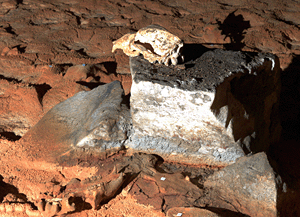
The cave also contains the bones of animals which used the cave for shelter. The most common animal bones found in the cave belong to the cave bear, a species that died out sometime between 25,000-20,000 years ago. There is evidence for at least 190 bears in the cave; they probably used the cave for hibernation during the winters. The cave bear bones have been dated, and the dates overlap with the periods when humans used this cave for painting. Most likely, humans visited the cave in the spring or summer when the bears were not there. However, the humans were certainly aware of the bears' presence, and on one occasion even set a cave bear skull prominently on a rock--perhaps during some kind of ritual, since there is evidence of a fire being lit nearby (see picture below). The bears sometimes scratched the walls, leaving claw marks on some of the paintings, and in other cases the human artists incorporated claw marks into their paintings.
The very early dates for these paintings shocked many archaeologists, who thought that since the paintings were so sophisticated, they must be later (after artists had a few thousand years to hone their technique). Some still refuse to accept the early dates. The artists in Chauvet Cave used some unusual techniques. For example, the cave walls are covered in a thin coating of brownish clay. The artists sometimes scraped this away to reveal the cream-colored limestone walls (you can see this in the rhino painting above--the artist has used this technique very carefully and selectively!).
Although there is plenty of evidence to suggest that humans visited this cave regularly, there is little evidence to suggest that humans actually lived here--eating meals, making tools, preparing leather for clothing, etc. In comparison, read about some of the evidence for the Mas d'Azil cave where the ibex spearthrower was found (one of the other objects in the gallery). We know, from caves like Mas d'Azil, that these people primarily ate animals like red deer, reindeer, and bison. Compare this to the animals you see in the painting above. What does this evidence suggest about the purpose of this cave? Why did people come here to paint--but not to do anything else?
Some Things To Consider In Your Response Paper:
1. What was your response to this piece of art? What drew your eye? You are encouraged to use first person (I/me) in your response paper. I want to know what you think.
2. What kinds of animals do you see in this cave painting? What relationship did humans have with these animals? Did humans hunt them? Eat them? Were humans perhaps hunted by these animals?
3. Think about this painting as a piece of art. First, keep in mind that the animals you see in this painting were probably not all painted at the same time. Instead they were added bit-by-bit over many years, perhaps even hundreds or thousands of years. Use the art terms we've discussed in class--terms like "line", "contrast", or "movement" might be particularly useful things to think about. How does the artist draw your eye, or suggest the life/vitality or movement of these animals? How does the artist work with the natural setting in the cave (the walls are, of course, not flat)?
4. Think about this painting as a piece of history, which can tell us about the lives and perhaps even the beliefs of people more than 30,000 years ago. Remember that this cave has little evidence for habitation--people probably didn't live here full-time. So, why did they come here and paint these images? These were people who were focused on survival in a harsh Ice Age environment. Why did they put time and effort into decorating these caves--and why did they choose the images that we see here? Use the evidence from the images above and the text provided here to support your argument.