"Images seem to speak to the eye, but they are really addressed to the mind.
They are ways of thinking, in the guise of ways of seeing."
--William Duff
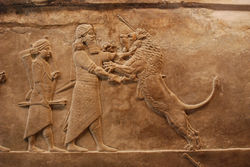
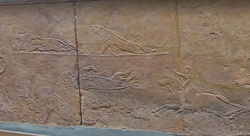
Lion Hunt of Ashurbanipal
645 - 635 BCE
 |  |  |
|---|---|---|
 |  |  |
 |
Material: alabaster stone
Size: each panel is about 5 ft tall (62 inches)
I have given you several images from a long relief that once adorned some of the walls of the North Palace in ancient Nineveh, capital of the Assyrian Empire.
First, take a minute or two to look closely at the images above. Write down your reaction to it--what did you think about when you first saw this? What parts of this artwork caught your eye? Why did you pick this sculpture for your response paper? Make notes on things that you notice about it. Also, write down any questions you have about it--what kinds of things would you want to know about this sculpture? Remember the questions we ask in class. You don't need to have answers for these questions yet, but keep them in your notes.
Once you have some questions written down, try to answer them by reading the information I've provided below about the sculpture and its context.
Context: Where Was It Found?
These sculptures were carved onto the wall of the North Palace, built by Ashurbanipal, King of the Assyrians from 668-627 BCE. Ashurbanipal was the last great king of Assyria (depending on how you define great, I guess); soon after his death, the empire collapsed. However, when this palace was built, the empire was at its largest extent. Inscriptions listing Ashurbanipal's achievements highlight his many military successes. Ashurbanipal was also well-educated. The ability to read and write was not widespread, since it took a significant amount of time and effort to learn the thousands of cuneiform characters. Ashurbanipal valued learning so much that he amassed a huge library (for the time) of about 30,000 clay tablets detailing mathematical, scientific, and medical knowledge in addition to literature and history.
In class, we looked at a wall relief from an Assyrian palace representing a guardian/protective god and a long narrative relief showing the capture of the city of Lachish. In a similar way, this relief showing a lion hunt was meant for public view, and was part of the way King Ashurbanipal presented himself and his power.
Fun fact: Some scholars believe that the Hanging Gardens of Babylon actually weren't at Babylon--they were at Nineveh, built by one of Ashurbanipal's predecessors around 700 BCE. According to this theory, King Sennacherib built the Hanging Gardens in part to house plants and trees brought from every corner of his empire (another way to show power and territorial control).
Some things to consider in your response paper:
-
What was your response to this piece of art? What drew your eye? You are encouraged to use first person (I/me) in your response paper. I want to know what you think.
-
Consider the actual sculpture very carefully. Try to imagine the artists carving it from stone. How did the artists make use of line, texture, or scale to show important details and draw your eye to specific elements of the relief? Which figure(s) do you think are representing Ashurbanipal, and what details help you make that determination? Try to put yourself in the mind of the artist. What is the "story" the artist is trying to convey? (I don't mean to imply that this sculpture shows a linear narrative with one beginning and one end. Instead, you've got several individual scenes showing the king in different moments of the lion hunt. I just mean that, as I often say in class, every object has a story--what's this one?)
-
Think about where this sculpture was located. What kind of message was Ashurbanipal trying to send by having his artists carve this relief? Who was meant to see this? How were they meant to react/feel? How do you think you would feel if you were walking through the palace to meet Ashurbanipal for the first time, and you saw all these images?
-
Wherever possible, use evidence from the cultural details I gave you above. Can you connect any of those historical details (or things we discussed in class) to the imagery in these reliefs?