"Images seem to speak to the eye, but they are really addressed to the mind.
They are ways of thinking, in the guise of ways of seeing."
--William Duff
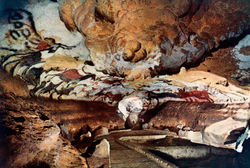
Hall of the Bulls
Around 19,000 years old
 |  |  |
|---|---|---|
 |  |
Material: charcoal- or mineral-based pigments on limestone
Size: the largest of the bulls is 17 feet long
First, take a minute or two to look closely at the painting in the images above. Write down your reaction to it--what did you think about when you first saw this? What parts of this artwork caught your eye? Why did you pick this painting for your response paper? Make notes on things that you notice about it. Also, write down any questions you have about it--what kinds of things would you want to know about this painting? Remember the questions we ask in class. You don't need to have answers for these questions yet, but keep them in your notes.
Once you have some questions written down, try to answer them by reading the information I've provided below about the cave painting and its context.
Context: Where Was It Found?
This room of wall paintings comes from a cave complex at Lascaux in France. The cave was first discovered in 1940 by some boys who were trying to rescue their lost dog. They ventured into the cave, saw all the paintings, and told their schoolteacher, who published the find in the local newspaper. Gradually archaeologists heard about the site and came to investigate. The caves were opened to the public after World War II, but the changes in temperature and humidity caused by the visitors' presence caused great damage to the paintings. The caves were closed in 1963, and only a few scientists or archaeologists are allowed in every year. Mold and fungi have spread along the walls, covering some paintings; the mold is currently impossible to remove without damaging the paintings underneath. France recently built a replica of the entire cave for visitors to experience, since the original cave environment is so fragile.
The complex contains more than 600 paintings, as well as numerous other finds to suggest how the Stone Age artists actually created these paintings. The evidence includes:
-
Dozens of stone lamps which once contained animal fats and a wick; these would have provided light for the artists working in these caves far from natural light. Archaeologists conducted experiments by producing their own stone lamps, filling them with animal fat (tallow), and using various substances as the wick. They found that these lamps would last about an hour, burned without smoke, and gave as much light as an ordinary candle.
-
Holes in the rock for wooden scaffolding. In many places, including the Hall of the Bulls, the flat surfaces of the cave (suitable for painting) are located three or four meters above the ground level. These holes were located in several places about two meters above the ground level, and had been packed with clay. Archaeologists think that the ancient artists inserted wooden poles into these holes to construct a level surface for the artists to sit on while they worked. Animal bones found on the ground suggest that the painters snacked on reindeer meat while they worked.
-
Crude "mortars" and "pestles" for grinding up the pigments, as well as other stone bowls (naturally hollowed out) which contained prepared pigments--the painters' "palettes". The painters favored black, yellow, and red colors, and more rarely white. Archaeologists have identified sources for all of these pigments nearby. The mineral powders were mixed with cave water, which contains unusually-high levels of calcium which helps the paint stick to the stone and last for thousands of years.
-
Archaeologists also tried making paintbrushes from locally-available supplies, such as twigs (the end was simply shredded to create a brush) or small bundles of bison hair. The archaeologists then practiced painting with the same pigments the Stone Age artists would have used, on stone, so that the archaeologists could observe whether their painting experiments looked like the paintings inside Lascaux Cave. These experiments were successful.
-
The archaeologists also tried painting one color over another to see what the effects were. In this way, they proved that the red cows in the Hall of Bulls were painted earlier than the black bulls (because the way the two colors looked when the archaeologists painted black over red matched what the archaeologists can see in the Hall of Bulls).
Archaeologists have excavated the soil inside the caves, and determined that the caves were occupied in a single, relatively short period around 17,000 years ago. Normally when archaeologists dig through the soil in a spot that has seen a lot of human activity, they will find layers from different periods (with the most recent on top, and the oldest layers on the bottom). Lascaux had only one layer of material, which suggests a relatively short occupation.
The most common animals represented in the caves are wild horses. Horned deer (including the extinct Megaloceros, a particularly huge deer species) are the second most common. Less commonly represented are aurochs (an extinct huge cow species), and bison. The "bulls" in the Hall of the Bulls are aurochs. Also found in the caves are seven felines, and single examples of animals such as reindeer, woolly rhinoceros, bear, and bird. There are also a couple of images of humans, but these are very rare.
Some Things To Consider In Your Response Paper:
1. What was your response to this piece of art? What drew your eye? You are encouraged to use first person (I/me) in your response paper. I want to know what you think.
2. What kinds of animals do you see in this cave painting? What relationship did humans have with these animals? Did humans hunt them? Eat them? Observe or admire them? Were humans perhaps hunted by these animals?
3. Think about this painting as a piece of art. First, keep in mind that the animals you see in this painting were probably not all painted at the same time. Instead they were added bit-by-bit over many years, perhaps even hundreds or thousands of years. Later artists made choices about where to place their compositions, and how to combine their art with the art of previous generations on the same wall. Use the art terms we've discussed in class--terms like "line", "color", "scale", or "movement" might be particularly useful things to think about. How does the artist draw your eye, or suggest the impressive size, life/vitality, or movement of these animals? Is the relative size of these animals realistic compared to each other, or could it symbolize something else? What would it be like to see these images, lit by torch or lamplight, 17,000 years ago?
4. Think about this painting as a piece of history, which can tell us about the lives and perhaps even the beliefs of people more than 15,000 years ago. Remember that this cave has little evidence for habitation--people probably didn't live here full-time. So, why did they come here and put time and effort into painting these images? Why did they choose the animals that we see here?