"Images seem to speak to the eye, but they are really addressed to the mind.
They are ways of thinking, in the guise of ways of seeing."
--William Duff
Ishtar Gate, Babylon
about 575 BCE
 |  |  |
|---|---|---|
 |  |  |
 |
Material: yellow and brown clay bricks, and other bricks covered with a blue glaze which may be made from ground-up lapis lazuli stone
Size: 46 ft tall, 100 ft wide
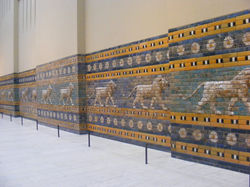
I have given you several images showing the Ishtar Gate, which once stood at one of the entrances to the city of Babylon, in modern-day Iraq:
-
Image 1: The gate as it currently stands in the Pergamon Museum in Berlin, Germany
-
Images 2-3: Close-up views of three of the animals which adorn the gate
-
Image 4: A panel showing trees which was originally built into the wall near the gate. You can also see these in the first image, where you can see how big they are compared to the rest of the gate
-
Image 5: The decoration also adorned the walls on either side of the gate--here you see a series of lions marching toward the gate.
-
Image 6: A digital reconstruction of what the gate (and the road leading up to it) might have looked like.
Keep in mind that what you see in the museum is missing several elements:
-
What you see in the museum is only the smaller, front part of the gate. The bigger second section, which would have stood behind it, is in storage because it's too big to fit into the museum.
-
The gate originally had doors and a roof made of cedar and bronze (see the text of the inscription below) which do not survive.
First, take a minute or two to look closely at the images above. Write down your reaction to this structure--what did you think about when you first saw this? What parts of this artwork caught your eye? Why did you pick this structure for your response paper? Make notes on things that you notice about it. Also, write down any questions you have about it--what kinds of things would you want to know about this structure? Remember the questions we ask in class. You don't need to have answers for these questions yet, but keep them in your notes.
Once you have some questions written down, try to answer them by reading the information I've provided below about the structure and its context.
Context: Where Was It Found?
This gate originally stood at one of the entrances into Babylon. Babylon has a long history, growing from a small town around 2300 BCE to the world's largest city, estimated at 200,000 people, at the time the Ishtar Gate was built.
The gate was built by the king Nebuchadnezzar II, who ruled Babylon from 605-562 BCE. His father participated in the rebellion that brought down the Assyrian empire. Nebuchadnezzar II established Babylon as the new power in Mesopotamia, filling the power vacuum left after the Assyrian empire's collapse.
The gate is named for the goddess Ishtar, who was seen as being similar to the Sumerian goddess Inanna (we met her in class--goddess of love, sex, fertility, war, and political power). Her sacred animal was the lion. The main patron god of Babylon, who was imagined to have a special connection with the city, was Marduk. Marduk was a god of justice/fairness, healing/regeneration, agriculture, and water. Every year when the Babylonians celebrated the New Year, the statue representing the god Marduk was taken out of the city and then brought back into the city in a huge, elaborate procession. The New Year's procession would have passed through the Ishtar Gate. Marduk's sacred animal was a mythical snake-dragon. The bulls in the Ishtar Gate may be a reference to the god Adad, another major Babylonian god who brought storms/rain--necessary for life, but also with the possibility of causing flooding and destruction.
Nebuchadnezzar placed an inscription near the gate which recorded the construction project:
"Nebuchadnezzar, King of Babylon, the faithful prince appointed by the will of Marduk, the highest of princely princes, beloved of Nabu, of prudent counsel, who has learned to embrace wisdom, who fathomed their divine being and reveres their majesty, the untiring governor, who always takes to heart the care of the cult of Esagila and Ezida and is constantly concerned with the well-being of Babylon and Borsippa, the wise, the humble, the caretaker of Esagila and Ezida, the firstborn son of Nabopolassar, the King of Babylon.
Both gate entrances of Imgur-Ellil and Nemetti-Ellil following the filling of the street from Babylon had become increasingly lower.
Therefore, I pulled down these gates and laid their foundations at the water table with asphalt and bricks and had them made of bricks with blue stone on which wonderful bulls and dragons were depicted.
I covered their roofs by laying majestic cedars length-wise over them. I hung doors of cedar adorned with bronze at all the gate openings. I placed wild bulls and ferocious dragons in the gateways and thus adorned them with luxurious splendor so that people might gaze on them in wonder."
Some things to consider in your response paper:
-
What was your response to this piece of art? What drew your eye? You are encouraged to use first person (I/me) in your response paper. I want to know what you think.
-
Consider the structure carefully. Try to imagine the artists shaping the clay bricks and constructing the whole gate. How did the artists make use of color, texture, or scale to show important details and draw your eye to specific elements of the structure and its decoration? Try to put yourself in the mind of the artist.
-
Of course, the artists or craftspeople constructing the Ishtar Gate didn't really have much artistic freedom--they were carrying out a job for the king, who had presumably dictated what he wanted the gate to look like. Consider the different symbols in this structure: the different animals, the trees. What kind of message was Nebuchadnezzar II trying to send by having his artists create this gate? Also, consider the materials used. I mentioned the lapis lazuli-glazed bricks. Nebuchadnezzar II also pointedly mentions cedar--Babylon is located in a flat, desert-like area. There are no trees. The cedar had to be imported from Lebanon, so this was also a somewhat rare material.
-
Think about the experience of walking up the street toward this gate. First you would see the lions marching along, and the enormous trees. Then you would approach the gate and see the other animals. How do you think you would react/feel? Imagine what it would be like during the New Year's celebration.
-
Wherever possible, use evidence from the cultural details I gave you above, including the inscription Nebuchadnezzar II had built into the gate. An inscription like that is public, it is a form of self-presentation just like art (even if the majority of people couldn't read it--what do you think, does that defeat the purpose of creating the inscription if few people can read it? Who is the audience of this text?). What is Nebuchadnezzar II trying to communicate about himself and his city in this inscription?