"Images seem to speak to the eye, but they are really addressed to the mind.
They are ways of thinking, in the guise of ways of seeing."
--William Duff
Luristan Culture, Iran
800 - 700 BCE
 |  |  |
|---|---|---|
 | 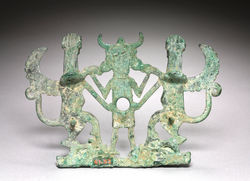 |
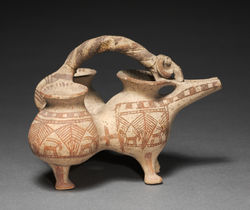
Material: the pitcher is clay and slip, the horse bit cheekpiece is bronze
Size: the pitcher is 7 x 7 x 8.5 inches, the horse bit cheekpiece is 5.5 x 8 in
First, take a minute or two to look closely at the images above. Write down your reaction to these objects--what did you think about when you first saw this? What parts of these artworks caught your eye? Why did you pick these objects for your response paper? Make notes on things that you notice about them. Also, write down any questions you have about them--what kinds of things would you want to know about these objects? Remember the questions we ask in class. You don't need to have answers for these questions yet, but keep them in your notes.
Once you have some questions written down, try to answer them by reading the information I've provided below about these objects and their context.
Context: Where Was It Found?
In class we examined a pair of objects produced by the people of Luristan, Iran--a bronze horse bit decorated with winged ibexes, and a silver cup decorated with scenes of a warrior/hero attacking/subduing lions. The people of Luristan were a nomadic people who raised herds of sheep or goats and lived in the mountains of what is today northwest Iran. As a nomadic people, they did not have cities, but moved from place to place based on the needs of their community and their herds; their horses were vital for this lifestyle. Although they did not have cities or many of the other cultural features we often identify with "civilization", the people of Luristan produced large numbers of bronze objects, including bits. Remember that a horse bit is the metal rod that a horse bites down on, and to which the reins are attached. When the rider tugs on the reins, it will create pressure in the horse's mouth that will tell the horse to stop or turn a certain way. Bronze was one of the materials used by horse cultures to make bits in ancient times, so a bit like this one might have been used in real life (consider the size and elaborate design of this cheekpiece, though--do you think it was used in everyday life? Or would it have been for special occasions, or perhaps even purely symbolic and not meant for actual use?). The object above is missing the actual bit; all you are seeing is one of the two decorated cheekpieces that would have been located on either end of the bit. The bit would have projected through the hold in the man's middle. I'm honestly not quite certain which animals are represented in the cheekpiece; the museum unfortunately did not provide a side view. They might be sphinxes or griffins, based on what I can see.
The presence of large numbers of bronze objects in the tombs and temples of the people of Luristan suggests that they had some source of wealth. Aside from their herds, another possibility is their location. First, the mountains were the places where you would find deposits of the copper and perhaps even the tin required to make bronze. Second, Luristan was located in between major civilizations (Mesopotamia to the west, and early India to the east) which traded with each other. The people of Luristan may have supported those trade routes--and, as middlemen, they might also have taken some of the profits. In general, it is a profitable thing to be located along a major trade route!
These objects are identified as coming from the culture of Luristan in part because of their style. If you compare the imagery of these two objects to the Luristan objects we examined in class, you will probably notice some similarities. Certain symbols tend to have meaning in a particular culture, and this helps us identify which culture produced these objects. I cannot be more specific about where these objects were found, however. Both objects are currently kept in the Cleveland Museum of Art, which does not list any information about their findspot in Iran. This is probably because these objects were looted--dug up by local tribespeople and sold illegally on the art market. Archaeologists have since done some excavation in the area, mainly focusing on tombs. It is possible, though not certain, that the pitcher and horse bit cheekpiece above came from a tomb.
The cheekpiece is made out of cast bronze, which was then cut (incised) to add the details. You should imagine the artist starting with a mold, probably made out of clay, with the design in "negative" space. The molten bronze would then be poured into the mold, where it would fill up the negative space, and left to cool. Finally the mold would be broken and the bronze object would be incised and polished. The green color of the object is due to the weathering of the copper, which makes up 9/10 of bronze.
Some things to consider in your response paper:
-
What was your response to these objects? What drew your eye? You are encouraged to use first person (I/me) in your response paper. I want to know what you think.
-
Consider the objects carefully. Try to imagine the artists producing these objects--shaping the clay, designing the bronze object, decorating them. How did the potter make use of color, texture, or shape? How did the bronze artist make use of texture, line, and shape? Try to put yourself in the mind of the artist.
-
Compare these objects to the artifacts from Luristan we looked at in class. In particular, I encourage you to think about the different animals represented on these objects--both mythical and real--and the fact that the cheekpiece is a type of object associated with horses and horse-riding. What was the role of these animals in the lives of the people of Luristan? Why might these artists have been so inspired to create art with so many different animals in it? Also, the cheekpiece shows the "Master of Animals" motif we saw on the silver cup in class--why is that motif so popular among these people? Remember that the "Master of Animals" motif was popular in the Middle East for hundreds of years before this cheekpiece was created.
-
What kind of person do you think might have owned or used these objects? Try to imagine them in use in Luristan society. If the objects were found in a tomb, whose tomb do you think it might have been? Imagine the funeral procession and burial, with all these objects being put into the tomb. A funeral can be its own opportunity for self-presentation (if the deceased left behind detailed wishes) or for the surviving family to present itself to the community, whether it chooses to emphasize wealth or piety or some other set of values. What kinds of values do you see being expressed in these objects? Wherever possible, use evidence from the cultural details I gave you above.