"Images seem to speak to the eye, but they are really addressed to the mind.
They are ways of thinking, in the guise of ways of seeing."
--William Duff
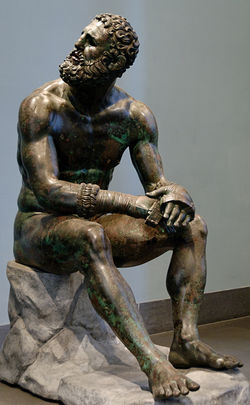
The Boxer Statue
sometime between 300-100 BCE
 |  |  |
|---|---|---|
 |  |
Material: bronze, with copper inlays showing wounds
Size: life-size
First, take a minute or two to look closely at the images above. Write down your reaction to this object--what did you think about when you first saw this? What parts of this object caught your eye? Why did you pick this object for your response paper? Make notes on things that you notice about it. Also, write down any questions you have about it--what kinds of things would you want to know about this object? Remember the questions we ask in class. You don't need to have answers for these questions yet, but keep them in your notes.
See larger images (click the magnifying glass to zoom in on each image): one, two, three, four
Once you have some questions written down, try to answer them by reading the information I've provided below about this object and its context.
Context: Where was it made? Where was it found?
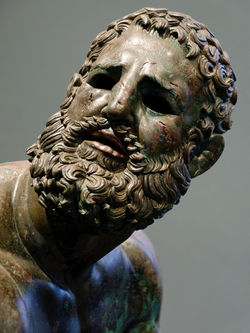
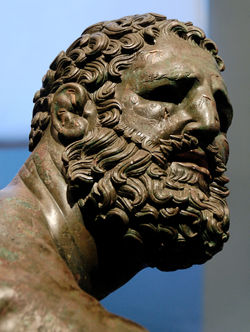
This statue was produced in Greece. The Greeks were masters of sculpting in bronze. They would cast the different sections of the statue separately, and then attach them together so seamlessly that it looks like a single sculpture. We don't know exactly when this statue was produced, but based on its style, it's probably sometime in the Hellenistic Period. In class, we ended our exploration of ancient Greece with the Classical Period, when the emphasis in art was on the ideal and perfect male body. Artists of the next few centuries, known as the "Hellenistic period", were less interested in ideals. Instead, these artists wanted to explore the diversity of the human experience--women and men, rich and poor, young and old. And so here, we have a statue of an athlete--but an older athlete, bearded, with wounds and scars and experiences. He is not depicted in the middle of the fight, fierce and powerful; instead, he is depicted either before or after the fight (what do you think?). These choices made by the artist produce a sculpture that is less about an "ideal" but at the same time perhaps more interesting to think about.
The statue itself was not found in Greece. In fact, although the Greeks produced vast numbers of bronze sculptures (which we know from ancient writings), the majority of these statues have not survived into the present. They were most likely melted down for their metal content. This statue had been transported to Italy, to Rome, sometime in its history. It was on display in the Baths of Constantine, a massive complex of public baths which included facilities for exercise--kind of like an ancient gym. The emperor Constantine, who funded the construction of the Baths of Constantine, also made sure that every inch of his public baths was covered with fancy marble and spectacular artworks for the people of Rome to admire. The idea, of course, was that the citizens of Rome would marvel at Constantine's wealth, good taste, and generosity--good propaganda for any leader. We know that this statue was displayed in the Baths of Constantine because it was buried here, probably deliberately, in the 5th century CE when Rome was under attack from various Germanic tribes. In 1886, the statue was dug up and put on display once more.
The statue depicts a boxer. He wears leather hand wraps which were common equipment for ancient boxers. He also physically bears the evidence of many fights--particularly noticeable are his cauliflower ears, a deformity caused by blunt trauma such as blows during boxing. Originally his eyes would have been made of inlaid materials such as white shell and black stone (to give the appearance of whites and pupils) but the inlay has not survived the centuries. You can see, if you look closely, copper inlays in some places which look like a bloody wound. Other green or red coloration is simply caused by age--bronze turns green over time as it is exposed to certain elements.
Some things to consider in your response paper:
-
What was your response to this object? What drew your eye? You are encouraged to use first person (I/me) in your response paper. I want to know what you think.
-
Consider the sculpture carefully. Try to imagine the artist creating this piece; put yourself into his or her mind. What kinds of decisions did the artist make when they were creating this piece, and why did they make those choices? Take your time looking at this sculpture, there are a lot of details!
-
Why did the artist decide to have the boxer sitting, rather than standing or in an "action" pose? What do you think the "story" behind this sculpture is--what is the boxer's story? Who is he? Is he being shown before a match? Afterwards? In between two matches? Use your imagination!
-
Think also about this sculpture ending up in Rome. What do you think a Roman man would have thought, seeing this statue as he visited the baths, perhaps after some athletic activity in the gym spaces of the baths? Why do you think the Romans collected so much Greek art?