"Images seem to speak to the eye, but they are really addressed to the mind.
They are ways of thinking, in the guise of ways of seeing."
--William Duff
Judgment of Paris pyxis
around 460 BCE
 |  |  |
|---|---|---|
 |
Material: clay and paint
Size: height 4 3/4 inches
First, take a minute or two to look closely at the images above. Write down your reaction to this object--what did you think about when you first saw this? What parts of this object caught your eye? Why did you pick this object for your response paper? Make notes on things that you notice about it. Also, write down any questions you have about it--what kinds of things would you want to know about this object? Remember the questions we ask in class. You don't need to have answers for these questions yet, but keep them in your notes.
Once you have some questions written down, try to answer them by reading the information I've provided below about this object and its context.
Context: What Do We Know?
We don't know much about the context of this vase. It was produced in Athens--the type of clay used, and the style of the painting, matches vases produced in Athens. This type of pottery is called "white-ground" because the clay is white-colored. Colors stand out particularly well against the white background. We do not know where this vase was found.
This vase is called a pyxis. Vases of this shape were generally used for storage, especially by women. This pyxis is quite small, not even five inches tall. What do you imagine the owner might have stored in here?
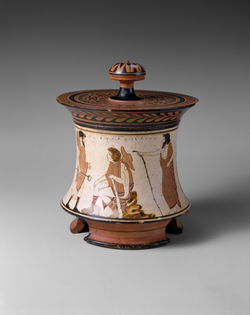
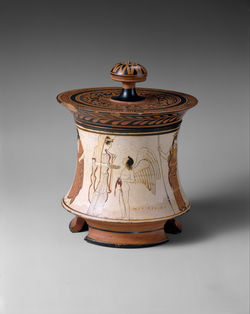
The story depicted on this vase is the moment which launched the Trojan War. The shepherd Paris, a prince of Troy, was out in the wilderness with his sheep when he was approached by the gods. In the vase above, Paris is looking toward the god Hermes, who has his special staff (the caduceus) and his winged sandals. Hermes, the messenger god, is leading three goddesses to meet Paris. Paris has been chosen to decide a very important question: which of the goddesses is the most beautiful? The backstory is that, during a wedding where many of the gods were invited, the goddess Conflict (Eris) was not invited (for obvious reasons) and was so insulted that she showed up anyway and threw an apple carved with the words "to the fairest" into the middle of the partying gods. Three goddesses rushed forward to claim the apple: Hera, wife of Zeus and queen of heaven; Athena, goddess of war and weaving; and Aphrodite, goddess of love and sex. Zeus, who is normally seen as the ultimate authority in the heavens, refused to decide this one (might have made things uncomfortable at home) and instead passed the decision off to Paris.
So here is Paris, confronted by Hermes, the three goddesses, and perhaps Zeus behind him (the bearded man with a staff). The three goddesses can be identified by certain details. Hera holds a staff and wears a crown (symbols of her status as queen of the gods). Athena holds a spear and helmet, since she is a goddess of warfare. Aphrodite, dressed in lighter clothes, is standing with her son Eros/Cupid. Paris must make a decision. As the story goes, each goddess tried to bribe him. Hera, queen of the gods, promised that if Paris picked her he would rule over a vast empire. Athena promised him success in warfare. Aphrodite promised him the most beautiful woman on earth--Helen of Sparta. Paris picked Aphrodite, and soon afterward set off to obtain Helen for himself. The problem, of course, was that Helen was already married. When Paris abducted her and married her, Helen's former husband (Menelaus, king of Sparta) was upset and launched a war to recover her which destroyed both Paris' home city Troy and Paris himself.
Some things to consider in your response paper:
-
What was your response to this object? What drew your eye? You are encouraged to use first person (I/me) in your response paper. I want to know what you think.
-
Consider the scene on the vase carefully. Try to imagine the artist painting this piece; put yourself into his or her mind. What kinds of decisions did the artist make (about lines, color, composition, etc.) when they were creating this piece, and why did they make those choices? By "composition" I mean choices about where certain figures or objects in the painting should be placed, relative to other figures.
-
How should we interpret this piece of art? Why did the artist put this myth on an object that was probably intended to be used by a woman? Why would a woman buy or use this object--what significance or meaning might this object have for her?