"Images seem to speak to the eye, but they are really addressed to the mind.
They are ways of thinking, in the guise of ways of seeing."
--William Duff
Hopi Pots
early 1900s
 |  |  |
|---|---|---|
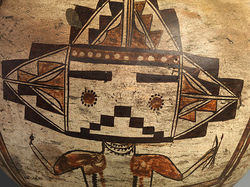 |  |  |
Material: local clay and paint
Size: Pot #1: 20 in diameter; Pot #2: 8.75 inches diameter; Pot #3: 12 in tall, 13.5 in diameter
First, take a minute or two to look closely at the images above. Write down your reaction to these objects--what details do you notice? Why did you pick these objects for your response paper? Make notes on things that you notice about them. Also, write down any questions you have about them--what kinds of things would you want to know about these objects? Remember the questions we ask in class. You don't need to have answers for these questions yet, but keep them in your notes.
Once you have some questions written down, try to answer them by reading the information I've provided below about this object and its context.
What do we know about these objects?
All of these pots are attributed to the artist Nampeyo. We examined one of her pots in class, so I encourage you to refer back to that video and compare that pot with the ones above. You may especially notice similarities between the pot we looked at in class and Pot #1 here. What did those symbols mean on the pot we examined in class? In the video, I also shared details about Nampeyo's life. Remember that many of her designs were inspired by ancient pottery designs from a site called Sikyatki--so her style of decoration was called Sikyatki Revival.
Pot #2. The bowl shape was most prevalent in Nampeyo’s work in the early 1900s. The bowl reaches its greatest width halfway between the top and bottom. The shoulders of the vessel are more sharply angled than in earlier pieces and culminate in a short neck and a small opening. Nampeyo followed the Zuni style of painting her designs on coiled-clay vessels covered with a thick white slip (clay thinned with water that acts like a glaze when fired). She typically used brown or black paint. Her descendants continue to make pottery today, carrying on many of the family designs and images.
Pot #2 contains several decorative elements. The Denver Art Museum, which owns this pot, describes them as:
-
Cloud bands. The lines that border the painted designs on the top and bottom of Nampeyo’s pot are also seen in historic Sikyatki pottery and are sometimes called “sky bands” or “cloud bands.”
-
Eagle tails. See the right side of the pot in the image above. Nampeyo repeated the “eagle tail” motif throughout her career, and it has become one of the Nampeyo family designs
-
Stylized bird and kilt. See the left side of the pot in the image above. The stylized bird design was one of the most frequently used decorative motifs on ancient Sikyatki vessels. Nampeyo adapted the motif and used it, with her own variations, on many of her pieces. Below the bird, Nampeyo painted a design identified as a “stylized kilt,” which resembles Hopi ceremonial kilts.
Pot #3. I have given you several images of this pot, which is held by the Metropolitan Museum of Art. You can see two different sides of this pot, with different human-like figures. The Met describes these figures as katsinam. According to the Harvard Peabody Museum, katsinam (singular: katsina) are benevolent spirit beings who visit the Hopi for about half of every year. According to Hopi tradition, the katsinam once visited in person, but now come as clouds down from the mountains or up from the earth. They begin arriving in late December, at the winter solstice. Masked and costumed Hopi men assume their powers and prestige in ceremonies and dances held until the katsinam depart in July. Though only men can be katsinam, women and children play important roles as their audience; all Hopi men and women belong to the Katsina Society. There are several hundred katsinam, who represent plants, animals, insects, human qualities, the creative force of the sun, and even death. Some are demons who frighten children into behaving properly; most are clan ancestors and beneficent beings. They are messengers who accept Hopi gifts and prayers for health, fertility, and rain and carry them back to the gods. Their role as rainmakers is particularly important to the Hopi, whose agriculture in the high, arid desert of northeastern Arizona has always been precarious.
Some things to consider in your response paper:
-
What was your response to these objects? What drew your eye? What do you like about them, or dislike? You are encouraged to use first person (I/me) in your response paper. I want to know what you think.
-
Consider the artistic details of these objects carefully. What kinds of decisions did Nampeyo make when she was creating these pieces, and why? Use your art terminology. You can consider these as three-dimensional objects with shape, form, etc., as well as using your terminology to describe the designs on the pots (line, color, etc.).
-
Place this object in its historical and cultural context. What kinds of cultural or religious ideas might the artist have been trying to communicate through her art? What would this mean to a person from the Hopi tribe?
-
Consider the fact that these objects were actually produced to be sold to non-Native buyers, as a way for Nampeyo to help support her pueblo. Does that alter the meaning of the pots, if they are removed from a Hopi cultural context and purchased by non-Hopi who may not fully understand the meaning of the symbols?