"Images seem to speak to the eye, but they are really addressed to the mind.
They are ways of thinking, in the guise of ways of seeing."
--William Duff
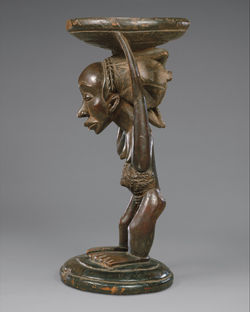
King's Stool
19th century CE
 |  |
|---|
Material: wood
Size: H 24 in.
First, take a minute or two to look closely at the images above. Write down your reaction to this object--what details do you notice? Why did you pick this object for your response paper? Make notes on things that you notice about it. Also, write down any questions you have about it--what kinds of things would you want to know about this object? Remember the questions we ask in class. You don't need to have answers for these questions yet, but keep them in your notes.
Once you have some questions written down, try to answer them by reading the information I've provided below about this object and its context.
What do we know about this object?
In many cultures throughout the southeastern region of the Democratic Republic of Congo—indeed, throughout much of Africa—the seats of leaders are important symbols of power and authority. Among the Luba, rank and title are indicated by the progressive ascension to more prestigious forms of seating, beginning with simple woven mats and proceeding onto animal pelts, clay thrones, and finally, sculpted wooden thrones such as this example. Stools figure prominently in the rituals in which Luba kings or chiefs take power and acquire the appropriate symbols of office. The main function of the stool was not to serve as a seat, but rather as a receptacle for the chief's spirit. Stools are such powerful emblems of a chief's power and identity that they were often kept secretly in a village different from their possessor's to reduce the risk of theft or desecration. The stools, swathed in white cloth and fastidiously guarded, were brought out only on rare occasions, reinforcing the notion that they and their insignia were not intended for human eyes, but rather for those of the spirit world. Among the Luba, all royal stools are considered replicas of an original prototype that was given to their first king, Mbidi Kiluwe, at the time when he took power.
The seat of this royal Luba stool is supported by a standing female figure who balances it on her head and the tips of her elongated fingers. Her small, pear-shaped body is detailed with elaborate scarification markings on the stomach and abdomen that, in past generations, enhanced a woman's body as signs how beautiful and civilized she was. Despite being a patriarchal society, the Luba peoples trace succession and inheritance through the female line. Consequently, figures that support chiefs' stools generally depict female ancestors. This Luba sculptural tradition was designed to identify and glorify the king, chiefs, and titled officials who constituted the complex hierarchy of leadership within the Luba empire.
Within this tradition of royal Luba artifacts, the styles of a few artists have come to be recognized and singled out. This Luba chief's ceremonial stool has been attributed to the Buli Master, one of the best-known sculptors of traditional African art, who was named by European scholars after a village in the eastern region of the Democratic Republic of the Congo where a number of his works were collected. The stool is part of a corpus of about twenty stylistically related works. Many of these entered European collections around 1900, and it is believed that the Buli Master was active in the middle to late nineteenth century.
Other formal characteristics of the Buli Master's corpus include enlarged, flattened hands turned palm forward; a heavy, four-lobed hairstyle crisply undercut at the back of the neck; and an expressive, mournful face. With its slightly aquiline nose, arching brows, and pursed lips, the face wears an expression often interpreted as suffering by Western viewers. The entire sculpture, carved of a single piece of soft wood, is now covered with a lustrous patina, the result of multiple applications of oil to the stool's surface.
Some things to consider in your response paper:
-
What was your response to this object? What drew your eye? What do you like about it, or dislike? You are encouraged to use first person (I/me) in your response paper. I want to know what you think.
-
Consider the artistic details of this object carefully. What kinds of decisions did the artist make when they were creating this piece, and why? Use your art terminology. How is the artist using things like line, texture, or proportion to highlight important parts of this sculpture?
-
Place this object into its historical and cultural context. What did the different elements of this sculpture mean in Luba society? How do the different parts of this sculpture convey the power of the king who sat on this stool? Why did the artist choose a female figure to support the stool?