"Images seem to speak to the eye, but they are really addressed to the mind.
They are ways of thinking, in the guise of ways of seeing."
--William Duff
Pamplona Casket
1004-1005 CE
 |  |  |
|---|---|---|
 | 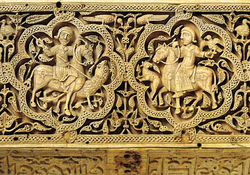 |
Material: ivory
Size: 9 in. high, 15 in. wide, 9 1/4 in. deep
First, take a minute or two to look closely at the images above. Write down your reaction to this object--what details do you notice? Why did you pick this object for your response paper? Make notes on things that you notice about it. Also, write down any questions you have about it--what kinds of things would you want to know about this object? Remember the questions we ask in class. You don't need to have answers for these questions yet, but keep them in your notes.
Once you have some questions written down, try to answer them by reading the information I've provided below about this object and its context.
What do we know about this object?
On the lid of the casket, a long inscription in Arabic calligraphy tells us:
“In the name of Allah, Allah be blessed, prosperity, happiness and attainment of expectations from pious works, and respite from the appointed time of death to the hâjib Sayf al-Dawla, ‘Abd al-Malik, son of al-Mansûr, may God grant him success. [This is part of it] from that which was ordered to be made under the supervision of the chief page Zuhayr ibn Muhammad al-‘Amirî, his servant in the year three hundred and ninety-five.”
The "year 395" is in the Islamic calendar, which starts counting from the year in which Muhammad returned to Mecca and took over. In our calendar, this gives us a year 1004-1005 CE. In this year ‘Abd al-Malik al-Muzaffar won a major victory over the Kingdom of Leon, and this object may have been produced to commemorate his victory.
The casket was produced in Cordoba in the official ivory workshops (note how the inscription says this was produced "under the supervision" of the "chief page"--it does not list the artist, just the bureaucrat in charge of the workshops). Inside the lid, a smaller inscription tells us that "This is the work of Faraj and his disciples". Certain parts of the work are also autographed with other names--probably the students of Faraj who were working on different parts of this object. On the shield of the hunter in the central medallion is the inscription: "In the name of God, God be blessed, felicity and prosperity". After Cordoba was conquered by Christians during the Reconquista, this casket was taken to Leyre, France where it served as a reliquary--a container for saints' relics--in Leyre Monastery.
I think you can figure out what's going on in the scenes in the first image. The second image shows three scenes. On the left, two people seated on thrones supported by sculpted lions; in the center, three musicians; on the right, a large figure (possibly the caliph) flanked by servants, one with a fly-swatter and the other with a small bottle perhaps containing perfume. The large figure sits on a throne supported by two sculpted lions.
Some things to consider in your response paper:
-
What was your response to this object? What drew your eye? You are encouraged to use first person (I/me) in your response paper. I want to know what you think.
-
Consider the artistic details of this object carefully. What kinds of decisions did the artist make when they were creating this piece, and why? What aspects of this artwork are characteristic of Islamic art?
-
Look closely at the different scenes on each panel of this casket. What are some common themes you see here? Why do you think the artist might have chosen these scenes/themes (hint: remember the event this object may be commemorating)? What kind of meaning(s) did the artist try to convey?
-
How do you imagine this casket might have been used by its owner? What does it tell you about the owner, that he received such an elaborate object from one of the royal workshops?