"Images seem to speak to the eye, but they are really addressed to the mind.
They are ways of thinking, in the guise of ways of seeing."
--William Duff
Celadon vessels
12th - 13th century CE
 |  |  |
|---|---|---|
 |
Material: clay with a celadon glaze
First, take a minute or two to look closely at the images above. Write down your reaction to these objects--what details do you notice? Why did you pick these objects for your response paper? Make notes on things that you notice about them. Also, write down any questions you have about them--what kinds of things would you want to know about these objects? Remember the questions we ask in class. You don't need to have answers for these questions yet, but keep them in your notes.
There are three vessels here:
-
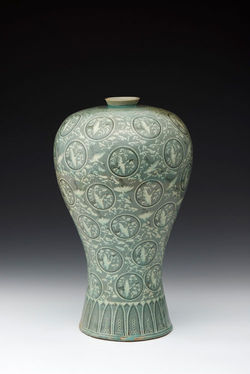
Image 1: About 12 inches tall, decorated with cranes and clouds, and perhaps flower petals at the bottom
-
Images 2-3: 9 1/4 inches tall, wine ewer, decorated with chrysanthemums and lotus petals at the bottom
-
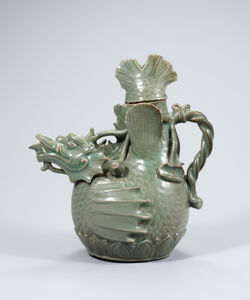
Image #4: 9 1/2 inches tall, dragon imagery with lotus petals at bottom, wine jug
Once you have some questions written down, try to answer them by reading the information I've provided below about this object and its context.
What do we know about this object?
These distinctive Korean vessels were created by shaping the vessel out of clay, then carving the designs into the surface. The designs were then filled in using white or black clay slip (clay mixed with water), and the whole vessel was then coated with a celadon (green) glaze. Finally, the vessel would be fired in a hot kiln.
These vessels have different shapes, and would have been used for different purposes. What kind of household do you think might have owned these types of vessels?
The artists decorated these vessels with symbols that had meaning in Korean culture (and East Asian cultures more generally). For example:
-
Clouds: one of the ten symbols of longevity in later Korean culture. Could also be connected with the Chinese "thundercloud" motif. As producers of rain, clouds sustain long life. In their swirling forms they contain the Daoist qi (chee), or breath of life. When their vapors gather around the mountaintops, they represent the uniting of yin and yang, soft and hard, changeability and permanence.
-
Cranes: one of the ten symbols of longevity in later Korean culture. Cranes were thought to live for hundreds of years. Because cranes mate for life, they were also symbols of harmony, a wish for a long marriage, and respect for one’s parents and ancestors. Cranes also signify promotion at court, as they appear in the rank badge of Korean Joseon civil officials. In Daoism the crane symbolizes transcendence and serves as a means of transport to heaven. The Japanese refer to the crane as “the bird of happiness;” the Chinese as “heavenly crane” believing they were symbols of wisdom. The powerful wings of the crane were believed to be able to convey souls up to heaven and to carry people to higher levels of spiritual enlightenment.
-
Chrysanthemums: Because these flowers bloom in the autumn, they are symbols of that time of the year. Chrysanthemums are one of the "four noble plants" (the other three are the Japanese apricot tree, the orchid, and bamboo). In China, a wine made from chrysanthemum flowers was thought to be good for your health, and so the flowers were connected with health and long life.
-
Lotus flowers: Buddhist symbol of enlightenment--the lotus flower grows in muddy locations, but rises above the muck just as a Buddhist tries to rise above worldly suffering and reach enlightenment. It was generally considered a symbol of prosperity and the purity (or virtue) of a person's heart/mind. Objects decorated with the lotus could be given as wedding gifts, and in that context would symbolize a wish for happiness for the young couple. Because the lotus bears both fruit and flower at the same time, it was also seen as a symbol of human fertility and childbearing; a child holding a lotus flower was a particularly good omen for childbearing.
-
Dragons: Beings of great power and generally good will toward mankind. Connected with (and thought to have power over) rain--and thus linked to agricultural fertility. Thus dragons became symbols of prosperity and good fortune in general. Korean dragons, unlike Chinese and Japanese dragons, were often shown with a beard. The kings of Korea sometimes wore clothing decorated with dragons.
Some things to consider in your response paper:
-
What was your response to this object? What drew your eye? What do you like about it, or dislike? You are encouraged to use first person (I/me) in your response paper. I want to know what you think.
-
Consider the artistic details of this object carefully. What kinds of decisions did the artist make when they were creating this piece, and why? Use your art terminology. How did the artist draw your attention to certain symbols, or arrange the decoration to complement the shape of the vessel?
-
How do you think these vessels might have been used, and what kind of person/people might have owned them?
-
What do the symbols on each of these vessels mean? If there is more than one symbol on a vessel, how do these symbols fit together to send a message about the hopes/wishes of the owner? Why do you think these kinds of symbols tended to be popular in Korean culture?