"Images seem to speak to the eye, but they are really addressed to the mind.
They are ways of thinking, in the guise of ways of seeing."
--William Duff
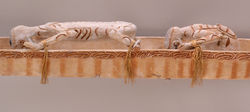
Wuramon (spirit canoe)
mid-20th century
 |  |  |
|---|---|---|
 |  |  |
 |
Material: wood, paint, sago leaves
Size: Length: 28 ft.; height 20 1/2 inches x width 16 inches
First, take a minute or two to look closely at the images above. Write down your reaction to this object--what details do you notice? Why did you pick this object for your response paper? Make notes on things that you notice about it. Also, write down any questions you have about it--what kinds of things would you want to know about this object? Remember the questions we ask in class. You don't need to have answers for these questions yet, but keep them in your notes.
Once you have some questions written down, try to answer them by reading the information I've provided below about this object and its context.
What do we know about this object?
Asmat spirit canoes (wuramon) are ceremonial carvings in the form of supernatural vessels. Wuramon are created for a one-time use during emak cem (the bone house feast), a ceremony that celebrates the spirits of the recently dead and the initiation of young boys. After being secluded within a ritual house for several months, the boys emerge one by one and crawl across the wuramon on their bellies. As each crosses the vessel, he is transformed from a boy into a man. Once across, he is seized by a man who cuts designs into his body; these heal into permanent scarification patterns that mark him as an adult. Crewed by spirits, the wuramon has no bottom to its hull, as spirits do not require a complete hull for their journey.
The spirit figures have a dual nature: their outer forms portray supernatural creatures, but each is named for a specific recently deceased ancestor, whose spirit it embodies. A turtle (mbu), a fertility symbol because of the numerous eggs it lays, appears near the center of this wuramon. Behind it is an okom, a dangerous Z-shaped water spirit. The other figures, gazing down through the bottomless hull, represent menacing water spirits (ambirak) or human-like spirits (etsjo). A hammerhead shark is depicted on the prow.
Some things to consider in your response paper:
-
What was your response to this object? What drew your eye? What do you like about it, or dislike? You are encouraged to use first person (I/me) in your response paper. I want to know what you think.
-
Consider the artistic details of this object carefully. What kinds of decisions did the artist make when they were creating this piece, and why? What do you think they might mean for the people who created and used this object? What does the placement and form of the figures suggest about the meaning of this object? Look closely and carefully at each of the figures, and think about the choices the artist made and what meaning(s) they might have been trying to convey. Also, consider the potential symbolic meanings of the canoe. Why use a canoe in an initiation ritual?
-
The spirits are also each named for a recently-deceased ancestor, so they also commemorate the dead. Why do you think an object used in an initiation ritual for young men would also commemorate deceased ancestors?
-
Put yourself in the shoes of a young man going through this initiation ritual—what would it be like? What kind(s) of memories or meanings would you attach to this object?