"Images seem to speak to the eye, but they are really addressed to the mind.
They are ways of thinking, in the guise of ways of seeing."
--William Duff
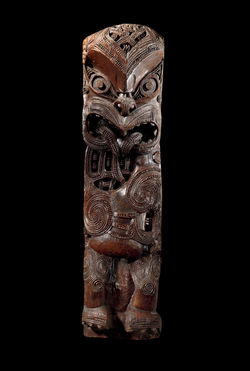
House post (ano) figure
1800s CE
 |
|---|
Material: wood
Size: H. 43 in x W. 11 in x D. 5 1/8 in
First, take a minute or two to look closely at the images above. Write down your reaction to this object--what details do you notice? Why did you pick this object for your response paper? Make notes on things that you notice about it. Also, write down any questions you have about it--what kinds of things would you want to know about this object? Remember the questions we ask in class. You don't need to have answers for these questions yet, but keep them in your notes.
Once you have some questions written down, try to answer them by reading the information I've provided below about this object and its context.
What do we know about this object?
Large communal meeting houses served, and continue to serve, as important focal points for the community among the Maori people of New Zealand (Aotearoa). Richly adorned with carvings depicting ancestors and figures from Maori mythology, the meeting house functions as council chamber, guest house, community center, and gathering place for the discussion and debate of important issues. Meeting houses are particularly important as places where the local group's history, customs, and genealogy are preserved and passed down to succeeding generations. The structure of the meeting house itself represents the body of a primordial ancestor — the ridge pole of the roof is the spine, the rafters the ribs, the gable boards on the exterior the outstretched arms, and the gable ornament at the peak of the roof the face. The interior is extensively decorated with carved panels and other architectural members depicting powerful ancestors, both male and female.
These ancestor images constitute a visual history of the group, simultaneously representing and embodying the spirits of its illustrious forebears. Many represent prominent warriors who, in the past, fought to protect the community. Depicting an ancestor from the Te Arawa region, this panel once adorned a Maori meeting house and may depict an ancient warrior.
Compare the figure's expression to the Maori haka dance. Remember the video I showed in class, which you can find here.
Also consider traditional Maori facial tattoos such as this.
In class, we examined the little greenstone ancestor figure from the Maori culture, as well as the carved lintel from a similar meeting house.
Some things to consider in your response paper:
-
What was your response to this object? What drew your eye? What do you like about it, or dislike? You are encouraged to use first person (I/me) in your response paper. I want to know what you think.
-
Consider the artistic details of this object carefully. What kinds of decisions did the artist make when they were creating this piece, and why? Consider the expression, form, and decoration of this figure—what anatomical parts are being emphasized? Think about the decoration in relation to the Maori haka dance, facial tattoos, and the other kinds of Maori art we looked at in class.
-
Place this object into its historical and cultural context. What kinds of meaning(s) did a figure like this have in Maori culture? Consider also the fact that it was placed in the community's meeting house, rather than somebody's personal home. What kinds of activities went on in this space, and how does that affect the meaning of this object? Imagine if you were a member of this community--how would you feel, or what would you think, seeing this object in the meeting house?