"Images seem to speak to the eye, but they are really addressed to the mind.
They are ways of thinking, in the guise of ways of seeing."
--William Duff
Totem Pole
late 19th century
 |  |  |
|---|---|---|
 |  |  |
 |  |  |
 |
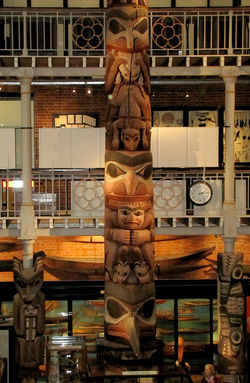
Material: wood (red cedar) and paint
Size: 37 feet tall
First, take a minute or two to look closely at the images above. Write down your reaction to this object--what details do you notice? Why did you pick this object for your response paper? Make notes on things that you notice about it. Also, write down any questions you have about it--what kinds of things would you want to know about this object? Remember the questions we ask in class. You don't need to have answers for these questions yet, but keep them in your notes.
Once you have some questions written down, try to answer them by reading the information I've provided below about this object and its context.
What do we know about this object?
The totem pole is from the Haida community of Massett. It originally stood outside Star House in a village called Massett (Haida name Uttewas), on Graham Island, Queen Charlotte Islands (which the Haida call Haida Gwaii) in British Columbia, Canada. The house was built around 1882 and belonged to chief Anetlas (c.1816 - 1893). The pole was originally raised at a potlatch marking Anetlas’ adoption of a young girl. A potlatch is a ceremony held by peoples of the Northwest Coast at which a person is given traditional family rights; it involves reciting family lineages and rights in front of witnesses from other families. The guests are given gifts and a feast, and their acceptance of these marks their agreement to uphold the rights transferred to the person in that potlatch.
The pole is carved with crest figures that relate to family lineages, status and rights. The carved motifs, such as the striking raven’s head, denote ancestral beings and stories related to the chief’s lineage and, more especially, that of his wife, a member of the Haida’s Raven moiety. Carved figures on crest poles remind viewers of the stories of how ancestral beings bestowed certain rights and property on a family. The figures depicted on this pole are, from the top:
-
Three watchmen, facing outward from the house. These figures watch for danger emanating from both the supernatural and the everyday worlds.
-
Bear, with a Frog in its mouth and a bear cub between its legs. The Bear is a symbol for power, courage, physical strength and leadership. The Bear is a symbol of great power and is always welcomed as a high-ranking guest. With his human-like qualities, he is known as the elder Kinsman who teaches the legends and dances. The Bear demands great respect, and symbolizes his awesome power over life and death. The Frog is also an important symbol. Since he is living in two worlds, water and land, the Frog is revered for his adaptability, knowledge and power to traverse worlds and inhabit both, the natural and the supernatural. Frogs are used by Shamans as spirit helpers who provide the voice of the people. The Frog is the great communicator and considered to be good luck. Through language or speech, knowledge and power can be shared or exchanged with others.
-
Bear, holding a human, with two bear cubs at its feet. This image probably is a visual representation of the following myth: In West Coast culture, there are several legends telling of a Chief's daughter being abducted by a bear. The high ranking woman had been out in the woods picking berries and stepped on some Bear dung and began to curse out loud, insulting their cleanliness. Two Bears nearby heard her and decided they would not tolerate such insolence. They felt the disrespectful woman had to be punished. To do this, one Bear transformed himself into a very handsome man who approached this woman, and seductively lured her to accompany him to his mountain home. When she did, she fell in love with him and became partially Bear-like herself. She later married him and had twin cubs. Their children were born as little creatures that resembled bears who could metamorphose themselves into human form like their father. The woman's brothers eventually found her and, in an unequal contest, killed her husband. They returned to the village but the two bear sons did not feel comfortable and eventually left to return to the forest. All Bear Clan members are descended from this woman and her two sons.
-
Raven, with a human between its wings: Raven is a "trickster" figure--a mythological figure who is always causing chaos or trouble, often trying to improve his own life, but in the process he often inadvertently helps mankind. He is a revered and benevolent transformer figure who helps the people and shapes their world for them, but at the same time, he is also a trickster character and many Haida stories about Raven have to do with his frivolous or poorly thought out behavior causing trouble for him and the people around him. For example, in Haida mythology, it is Raven who first stole light (which was being hoarded by an old man) and brought it into the world. See the full story here. Often, the bottom of the totem pole--which is the most visible to people on the ground--contained the most important symbolism. Recall that the wife of the pole's owner was from the Raven lineage.
For more information about how the pole was made, listen to this interview here.
The pole came to the Pitt Rivers Museum in 1901, donated by Professor E.B. Tylor. Tylor purchased the totem pole for $36 and shipped it to England by rail and steamer. To make transporting the pole easier it was cut in two and the Raven’s beak removed. The three watchmen on the top of the pole have lost some of their rings on top of their heads. Early photographs of the pole outside Star House show it as having more rings on the watchmen’s hats than it now does. The central figure had 9 rings and now has 4, the figures on either side had 4 and now have 3. These rings symbolize previous potlatches held by the owner of the pole and are an indication of his status in the community. Museum staff now think that perhaps the rings were removed to fit the pole in the rail container on which it was shipped across Canada.
Some things to consider in your response paper:
-
What was your response to this object? What drew your eye? What do you like about it, or dislike? You are encouraged to use first person (I/me) in your response paper. I want to know what you think.
-
Consider the artistic details of this object carefully. What kinds of decisions did the artist make when they were creating this piece, and why? Use your art terminology. Pay attention to color, scale/proportions, the use of line/shape, etc.
-
The symbols on this totem pole are all connected to myths--how did the artists tell each story visually? What symbolism or meaning does each component of the pole possess?
-
Place this object in its historical and cultural context. Why did Anetlas have such an elaborate pole carved to celebrate the adoption of a new family member--how is the totem pole connected to family/lineage? What did this pole mean to the people of this village who saw it every day?