"Images seem to speak to the eye, but they are really addressed to the mind.
They are ways of thinking, in the guise of ways of seeing."
--William Duff
Roman Rings
1st century BCE - 4th century CE
 |  |  |
|---|---|---|
 |  |  |
 |  |
I have given you images of several Roman rings, of varying quality and expense.
First, take a minute or two to look closely at the images above. Write down your reaction to each object--what details do you notice? Why did you pick these portraits for your response paper? Make notes on things that you notice about them. Also, write down any questions you have about them--what kinds of things would you want to know about these objects? Remember the questions we ask in class. You don't need to have answers for these questions yet, but keep them in your notes.
Once you have some questions written down, try to answer them by reading the information I've provided below about this object and its context.
Finger rings were a very common piece of jewelry in ancient Rome. Men might wear a ring which could be used as a seal during business transactions, to identify them in place of or in tandem with a signature. Men or women might wear a ring because they found it beautiful, or the image on the ring was somehow meaningful. Some rings are small enough that it is clear they were worn by children. The Romans also gave engagement rings--the handshake was a symbol of marriage, and is frequently found on rings that may have been used for this purpose (see the first ring above).
Many of these rings are made out of gemstones such as carnelian. To see the process of carving a gemstone, click here (video).
Ring #1: Gold ring with a handshake. 1/2 x 3/4 inches, 0.5 oz. 3rd century CE.
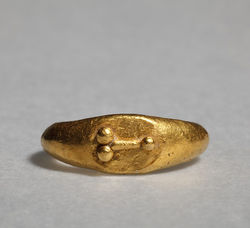
Ring #2: Gold ring with a phallus. (Remember our discussion in class about the symbolism of the phallus--meaning fertility, prosperity, and good luck!). 1/2 inch diameter. Roman period (1st-4th centuries CE).
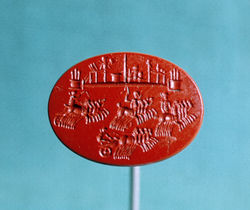
Ring #3: Jasper stone which would have been set into a ring. 7/16 of an inch x 9/16 of an inch. 2nd-4th century CE. Carved with an image of a chariot race in the circus, a popular Roman entertainment. The Circus Maximus in Rome could seat 250,000 people, according to the ancient Roman author Pliny; modern scholars, looking at the size and archaeological remains of this structure, suspect he was exaggerating and the real seating capacity might have been closer to 150,000. That's still a lot of spectators! The circus was a long oval structure, with seating around the edges in tiers. Down the center of the track ran the central "spine" which the chariots had to race around. You see this structure on the ring, at the top. There was a device for keeping track of the number of times the chariots had circled the track. There were four "teams", distinguished by colors (red, white, green, blue). You will note that there are four chariots in the carving above--perhaps referring to the four colors/teams. Fans were often loyal to one team/color and paid close attention to the horses and charioteers for their team; victorious charioteers had the potential to become local celebrities. Much like modern horse racing, betting on the races was common.
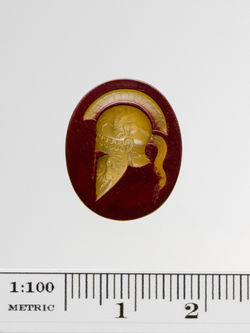
Ring #4: Jasper stone which would have been set into a ring. The artist has found a stone containing two colors--red and yellow--and carved the stone cleverly so that the design is yellow while the background is red. 13/16 of an inch. 1st century BC-3rd century CE. Carved with an image of a helmet. On the top of the helmet is the hero Bellerophon, riding Pegasus. On the cheekpiece of the helmet is the monster Bellerophon defeated, the Chimaera. There is also a running dog.
Ring #5: Carnelian stone. 1st century CE. 5/8 of an inch. Shows the face of a child. The Greek letters Tuxia are carved toward the bottom. This could be a personal name, or it could be related to the ancient Greek word "tyche" meaning "luck" (or the personal name might be derived from the word, just like our modern personal names also have meanings). Greek was still spoken during the Roman Empire, particularly in the eastern part of the empire.
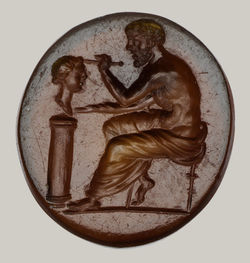
Ring #6: Carnelian stone. 1st-3rd century CE. 1/2 inch. Shows an artist at work.
Ring #7: Sard stone (related to carnelian). 1/2 inch. Shows the goddess Fortuna ("luck") with a cornucopia full of food/fruits, and a ship's rudder. On a boat, the person at the rudder guides the ship by moving the rudder; in the same way, Fortuna "guides" the lives of her worshippers. LOTS of Roman rings showed various deities, which speaks to the important role religion played in people's lives, and the incredible diversity of deities in a polytheistic belief system.
Ring #8: Glass paste meant to imitate carnelian. 0.35 inches. 1st-2nd century CE. Shows a snake coiled around a cornucopia. On the right and left are two ears of wheat. Nowadays, under the influence of Christian beliefs, snakes tend to be seen negatively, as "evil" creatures. The Romans did not see snakes this way, however. Snakes were seen as positive symbols, particularly due to the fact that they shed their skin and became "reborn". They were animals of the earth (think of garden snakes), and so they could be associated with agriculture and growth. And some snakes were believed to heal people; the healing god Asclepius often had a sacred snake or two in his temple which were believed to sometimes cure the sick.
Some things to consider in your response paper:
-
What was your response to these objects? What drew your eye? You are encouraged to use first person (I/me) in your response paper. I want to know what you think.
-
Consider the details of each ring carefully. What kinds of decisions did the artists make when they were creating these rings or gemstones, and why did the artist make those choices? Use your art terminology.
-
Keep in mind the materials used, too. I tried to select a variety. There are gold rings, there are gemstones such as carnelian and jasper, and the last ring stone is actually glass paste that has been shaped and carved to look like a more expensive carnelian stone. Rings, then, could have been purchased and worn by people at all levels of society. What do you think it might say about someone that they were wearing a gold ring, vs. a gemstone ring, vs. a ring where the "stone" is actually just glass paste?
-
We don't know whether these rings were made "to order" to match a customer's request, or whether the artists produced a range of different images and a customer could just pick the one they liked. But it seems logical that the ring often had some meaning or significance for the person who purchased and wore it. Why do you think someone might have worn each of these rings? What do these images tell us about the priorities, hopes, or worries of ancient Roman society?