"Images seem to speak to the eye, but they are really addressed to the mind.
They are ways of thinking, in the guise of ways of seeing."
--William Duff
Sutton Hoo Helmet
610 - 635 CE
 |  |  |
|---|---|---|
 |  |  |
 |  |
Material: mainly copper alloy, with some gold and iron; the small red stones are garnets
Size: 12.5 in high, weighs 5.5 lbs (estimated)
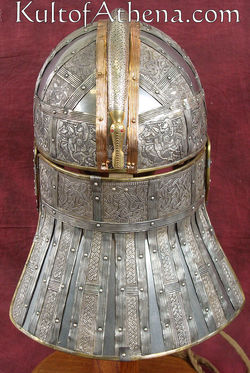
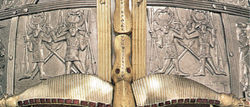
Note: The first image shows the helmet in its current condition. Images 2-6 show a replica which was made to give you some sense of what the original might have looked like. Images 7-8 are drawings of the two main decorative motifs that show up over and over on this helmet.
First, take a minute or two to look closely at the images above. Write down your reaction to this object--what details do you notice? Why did you pick this object for your response paper? Make notes on things that you notice about it. Also, write down any questions you have about it--what kinds of things would you want to know about this object? Remember the questions we ask in class. You don't need to have answers for these questions yet, but keep them in your notes.
Once you have some questions written down, try to answer them by reading the information I've provided below about this object and its context.
What do we know about this object?
The Sutton Hoo helmet comes from an extraordinarily rich burial found at Sutton Hoo in Suffolk, England. In 1939 the landowner asked an archaeologist to come and investigate the burial mounds on her property. The archaeologist, Basil Brown, started with the smaller burial mounds, and found that they had all been looted. This was not surprising, because burial mounds are big, visible monuments in the landscape, just begging robbers to come and see what riches are in them. Brown was therefore astonished when he began digging in the biggest mound and discovered a lavish "ship burial"--an entire 88-foot-long ship, filled with grave goods and the body of the deceased (although bones were never found--they probably disintegrated), and then buried in a giant earth mound. The ship itself had long since decayed, and the wood was all gone--but the nails remained, and the wood had stained the soil, leaving behind an outline of the ship. Some of the finds from the burial chamber included:
-
To the left of the deceased's head, the famous helmet (above)
-
To the right of the deceased's head, 10 silver bowls from Byzantium (in modern-day Turkey) and two silver spoons with the names of the Apostles
-
To the right of the body: spears, a sword and scabbard
-
The upper body of the deceased: gold buckle (we looked at this in class!), gold & garnet shoulder-clasps for chest armor (the armor itself does not survive), and a purse decorated with gold, garnet, and bone which contained 37 gold coins from France.
-
The lower body of the deceased: drinking vessels, including cups and two drinking horns made from the horns of an aurochs (bull--which at the time had recently gone extinct in Europe)
-
A heap of textiles had been piled to the left of the body
-
At the east end of the burial chamber (the feet end) were more textiles, a long coat of iron ring-mail, leather shoes, and a feather cushion. There was also an iron hammer-axe. A silver bowl made in Italy was also found here, as well as a silver ladle from somewhere in the Mediterranean, along with more small cups and other personal items, perhaps including objects for the deceased's toiletry and personal care. On top of all this stuff was a large decorated silver platter produced in the Byzantine Empire under the reign of Anastasius I (it's stamped with his marks). He ruled between 491-518 CE, so this platter was at least 100 years old when it was buried here.
-
At the east end, in the north corner, were several items for everyday domestic use. These included a large wooden tub with a smaller bucket inside; two small bronze cauldrons; a large bronze cauldron with a long iron chain to suspend it from the ceiling of a large hall.
-
At the west end (the head end) were: a shield decorated with a dragon and a bird; a small stag figurine that may have topped a scepter/staff; a bronze bowl from the eastern Mediterranean; a six-string lyre (musical instrument) of local production; and an elaborately-decorated large bowl designed to be hung on a wall as a display item. Above the deceased's head were traces of bone, which might have been part of a board game. It was not uncommon for leaders to be buried with board games, which were connected with strategic planning (including military planning).
Coins are an archaeologist's best friend, because people have been studying coins for hundreds of years and so we have a pretty good idea when most types of coins were being produced. The coins in this burial allowed the archaeologists to date the burial to the early years of the 7th century CE. Interestingly, these coins are not locally-produced; they were made in France.
In the 7th century CE, this part of England was a kingdom called East Anglia. A king of East Anglia named Raedwald died around 625, and this may be his burial. Maybe. He was one of the first English kings to convert to Christianity--but as we saw in class, people who converted to Christianity often retained aspects of their pagan culture for many centuries after conversion.
Old English poetry, such as the famous poem Beowulf, describe lavish ship burials. The idea seems to be that the deceased will have to make a journey to the underworld, which was thought to lie west across the sea. Therefore the deceased needed a ship, which would carry him/her and all his/her possessions into the afterlife.
During World War II, the finds were hidden underground in London's railway tunnels to protect them from bombing.
The structure of the helmet is iron, with small copper-alloy sheets laid on top for decoration. The sheets were "stamped" with two different patterns which are repeated all over the helmet. These are shown in the two drawings (images 7 & 8). A crest runs over the cap of the helmet and down the nose. The nose piece is copper alloy covered with a thin layer of gold ("gilded"). The eyebrows are copper alloy inlaid with silver wire. The nose and mouth-piece were cast as one piece. There are many animals worked into the decoration of the crest, nose, and eyebrows--look for the red garnet eyes. What kinds of animals do you think are being represented here?
The helmet rusted over time, and parts of it simply rusted away. It was also crushed (everything in the mound was crushed, actually) by the weight of the soil on top of it. When archaeologists found the helmet, it was fragmented into a bunch of heavily rusted pieces. Conservators cleaned it up as best they could, and archaeologists put the pieces together in what they think is the most likely arrangement. Because it is so fragmentary, I gave you the replica to look at so that you could better understand the original object.
Some things to consider in your response paper:
-
What was your response to this object? What drew your eye? You are encouraged to use first person (I/me) in your response paper. I want to know what you think.
-
Consider the details of this object carefully. What kinds of decisions did the artist make when they were creating this piece (line, composition, and material--using different types of metals in different ways), and why do you think they made these choices? Use your art terminology. What aspects of this helmet are characteristic of northern European art?
-
Why did the artist put these scenes and animals on this type of object? What is the artist trying to communicate through these images/symbols?
-
What can we say about the person who was buried with this helmet, based both on the helmet itself and on the other grave goods? What are some important details about the burial that you noticed in the description above, which might help us understand who this person was and what his/her life was like?
-
How do you think this helmet might have been used in life? Consider that many ancient cultures produced especially fancy versions of utilitarian objects, but reserved the fancy versions for special or ceremonial occasions. Why was the deceased person buried with all this stuff, including the helmet--what were his/her relatives trying to say about him/her by burying the deceased with these items? Why bury such a valuable object, rather than pass it down to a descendant?