"Images seem to speak to the eye, but they are really addressed to the mind.
They are ways of thinking, in the guise of ways of seeing."
--William Duff
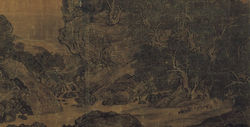
Travelers By Streams And Mountains
ca. 1000 CE
 |  |
|---|
Material: ink on silk
Size: 81 x 40 inches
First, take a minute or two to look closely at the images above. Write down your reaction to this object--what details do you notice? Why did you pick this object for your response paper? Make notes on things that you notice about it. Also, write down any questions you have about it--what kinds of things would you want to know about this object? Remember the questions we ask in class. You don't need to have answers for these questions yet, but keep them in your notes.
You can find a really high-resolution photo here. I suggest opening this and taking a few minutes to really closely examine all the parts of this piece. The detail is wonderful!
Once you have some questions written down, try to answer them by reading the information I've provided below about this object and its context.
What do we know about this object?
This painting was created by a Chinese landscape painter named Fan Kuan, around 1000 CE. At this time China had just emerged from a very chaotic period of history, when the Tang dynasty collapsed and there were decades of fighting over who would lead China. Finally around 960 CE the Song dynasty formed and restored peace to China. We know very little about Fan Kuan, but he was part of a movement of Chinese landscape painters who were active around 1000 CE. Considering what was going on in China politically, why do you think Chinese painters (and the noblemen who bought their work) might have been interested in vast landscape paintings like this one--rather than other subjects?
While the landscape is definitely the focus here, I swear there are some (very tiny) human and donkey figures--see if you can spot them!
This is a painting on silk, which has darkened over time. The original painting would have been brighter--but not necessarily more colorful. Many Chinese painters made a conscious choice to use limited color, or only black ink, in their painting. Why do you think an artist might make such a choice?
Consider this painting also in light of the "Three Teachings" of Chinese culture: Daoism, Confucianism, and Buddhism.
-
Confucianism focused on education (including arts like music or calligraphy) as a way to shape people into good moral citizens. Confucius also taught that everyone had a place in society which they should strive to fulfill--respect those above you in the social hierarchy, and fulfill your obligations to those below you.
-
Daoism focused instead on nature, teaching that one should look to nature for guidance about how to act and live, and try not to cause conflict--just "go with the flow". Daoists also revered certain "sages" who retreated into nature and eventually discovered great wisdom and even immortality. Mountains were a particular focus of both Daoism and, later, Buddhism (which brought a concept of "holy mountains" from Hinduism in India). Remember in class, we discussed the "mushrooms of immortality" which supposedly grew on some mountains.
Some things to consider in your response paper:
-
What was your response to this object? What drew your eye? You are encouraged to use first person (I/me) in your response paper. I want to know what you think.
-
Consider the artistic details of this object carefully. What kinds of decisions did the artist make when they were creating this piece, and why? How did they arrange all the major elements of this composition (the human figures, the different parts of the landscape)? Use your art terminology.
-
Why do you think landscape painting became so popular at this time in Chinese history?
-
How do you think the philosophies of Confucianism or Daoism might have influenced this artwork? Which principles of Confucianism or Daoism do you see reflected in this object? What does this painting tell you about how Chinese culture views nature and natural landscapes?