"Images seem to speak to the eye, but they are really addressed to the mind.
They are ways of thinking, in the guise of ways of seeing."
--William Duff
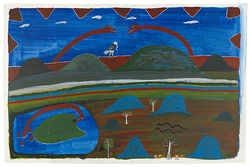
Limmen Bight River Country
late 20th century
 |
|---|
Material: paint on canvas
Size: 8 ft. x 8 ft.
First, take a minute or two to look closely at the images above. Write down your reaction to this object--what details do you notice? Why did you pick this object for your response paper? Make notes on things that you notice about it. Also, write down any questions you have about it--what kinds of things would you want to know about this object? Remember the questions we ask in class. You don't need to have answers for these questions yet, but keep them in your notes.
Once you have some questions written down, try to answer them by reading the information I've provided below about this object and its context.
What do we know about this object?
The Aboriginal artist who created this painting is Ginger Riley Munduwalawala. As we discussed in class, Aboriginal artists view their work as re-telling or re-presenting stories from the Dreamtime, the period when the world was created by the journeys and activities of various spirits. Each tribe is connected to a particular part of the land, and through the land, the tribe is also connected to the Dreamtime stories that took place in that spot. Aboriginal artists express themselves--their identity, their heritage--through their visual retelling of these stories; only the artists from a particular tribe have the right to create art showing the tribe's stories.
Ginger Riley Munduwalawala painted his mother’s country, focusing on the weather-worn rock formations known as the Four Archers near the mouth of the Limmen Bight River in south-east Arnhem Land. Riley depicted this landscape and its ancestral beings: Garimala the snake, who created the Four Archers; Ngak Ngak the white-breasted sea-eagle and guardian figure; the ceremonial shark’s liver tree; the Four Archers themselves; and the Limmen Bight River. Riley’s extraordinary creativity allowed him to reinvent this subject matter again and again, expressing in his work his vision of physical geography, creation knowledge and ancestral sites. His strong sense of place enabled this overview, and he painted, he has said, as if he was, ‘ … on a cloud, on top of the world, looking down … From the top I can see country right down to where I come from.’
The focus of the painting is the creation of the Four Archers by Garimala in the artist’s mother’s country. The island of Yumunkuni (Beatrice Island), seen in the lower left, was created by Ngak Ngak the Sea Eagle. Here, Bulukbun came out of the sea to devour the participants in a ceremony who had offended him by performing a ritual incorrectly. Ngak Ngak the Sea Eagle, shown in the upper centre of the painting devouring a snake, is the artist’s totem, and its depiction in the scene acts as a metaphor for the artist witnessing the creative acts of his ancestors. The central bands represent the Limmen Bight River; two images of the travelling Garimala are to the right; at the bottom is the shark’s liver tree; and to the left, angry Bulukbun with his fiery breath. The V-shaped decoration that frames the whole image is derived from designs painted on the shoulders of ceremonial participants.
Some things to consider in your response paper:
-
What was your response to this object? What drew your eye? What do you like about it, or dislike? You are encouraged to use first person (I/me) in your response paper. I want to know what you think.
-
Consider the artistic details of this object carefully. What kinds of decisions did the artist make when they were creating this piece, and why? The artist is telling a story, creating a narrative. How does Riley arrange the different elements/symbols/figures in this artwork to tell his story?
-
Place this object into its historical and cultural context. What is the meaning or significance of the story told in this painting? How does this painting show parts of the Aboriginal Dreamtime? How does it express aspects of Riley's identity?
-
Think about your own hometown or homeland. How would you represent it in art? What are the most important aspects of the story you would want to tell about your homeland? How is this similar to or different from Riley's depiction of his mother's country?