"Images seem to speak to the eye, but they are really addressed to the mind.
They are ways of thinking, in the guise of ways of seeing."
--William Duff
Hylestad Stave Church
End of the 1100s CE
 |  |
|---|---|
 |  |
 |  |
 |  |
Material: wood
Size: I can't find dimensions, but keep in mind these framed a doorway like the carvings we examined in class.
First, take a minute or two to look closely at the images above. Write down your reaction to this object--what details do you notice? Why did you pick this object for your response paper? Make notes on things that you notice about it. Also, write down any questions you have about it--what kinds of things would you want to know about this object? Remember the questions we ask in class. You don't need to have answers for these questions yet, but keep them in your notes.
Once you have some questions written down, try to answer them by reading the information I've provided below about this object and its context.
What do we know about this object?
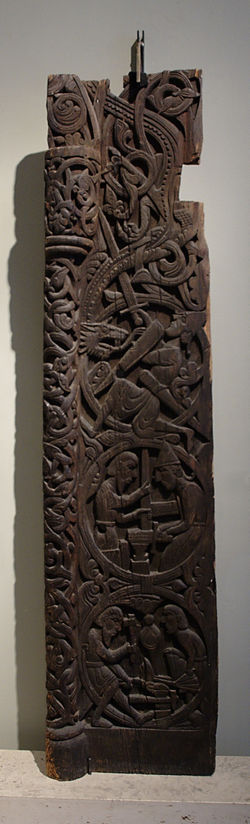
These two carved panels come from a wooden church in Hylestad, Norway. Christianity first came to Scandinavia in the 10th century, and gradually spread through these countries; by the 12th century Norway had established its own archdiocese. The Hylestad church was built in the late 12th or early 13th century, and was demolished in the 17th century. However, some carved panels were saved, including the two panels above.
Although these panels were decorating a Christian church, they show a pagan myth with a long history. The story of Sigurd the dragon-slayer is repeated in several different poems and sources, but the basic outline of the story is this:
Sigurd, who is of noble parentage, heard about a mythical treasure guarded by a dragon. He asked the smith Regin to make a sword that would destroy the dragon out of the pieces of his father's sword. Regin forges this sword and presents it Sigurd. Sigurd then goes in search of teh dragon Fafnir. He hides in a pit under a spot where he knows the dragon will pass, and when this happens, Sigurd stabs the dragon through the heart. Following the directions of the smith Regin, Sigurd roasts the dragon's heart over a fire. Sigurd touches the heart to see if it is done, and burns his finger; as he sucks on it, he consumes some of the dragon's blood, which enables him to understand the speech of birds. The birds tell him that Regin is plotting to kill Sigurd and take the dragon's treasure for himself. The birds advise Sigurd to kill Regin instead, and he does this. Sigurd then loads up his horse, Grani, with the dragon's treasure. This treasure, though, is cursed. Sigurd is killed by his brothers-in-law, who sink the treasure in a river to hide it. Gunnar, one of the brothers-in-law, is later captured by Atli (probably meant to be Attila the Hun) who desires the treasure. Gunnar refuses to reveal its location, and Atli orders him to be thrown into a pit of snakes with his hands bound. Gunnar's sister sneaks him a lyre, which he plays with his feet to lull the snakes to sleep--except for one large snake, which fatally bites Gunnar. As the dragon Fafnir told Sigurd with his dying breath, the treasure "will be the death of all who possess it".
In the carvings above, Regin has a beard while Sigurd wears a pointed helmet. Image #1 shows three episodes from this story, starting at the bottom. Image #2 adds three more episodes, starting from the bottom up to the top. The next six images zoom in on each of the six scenes so that you can see the details more clearly. Read the story above carefully--can you identify each of the scenes?
Some things to consider in your response paper:
-
What was your response to this object? What drew your eye? You are encouraged to use first person (I/me) in your response paper. I want to know what you think.
-
Consider the artistic details of this object carefully. What kinds of decisions did the artist make when they were creating this piece, and why? For example, you might discuss the artist's use of line (and how they work with/incorporate the grain of the wood), the use of relief carving (which creates light and dark places in the artwork), or composition (where the different figures/elements are placed, and their relationships to each other). Use your art terminology. What aspects of this carving are characteristic of northern European art?
-
This artwork tells a narrative. How does the artist tell this story visually? How do they link the different episodes together? How do they provide visual clues that help you follow the story?
-
The myth of Sigurd and Fafnir was very popular in Scandinavia. Why do you think that was--why did this myth appeal to people? How do you think the meaning of the myth might have changed when it was carved onto a Christian church? What meaning do you think a Christian person might have drawn from this story?Could these carvings be reinterpreted to fit into Christian ideas about good and evil? The image of Gunnar and the snakes was quite common in Christian Scandinavia, for example carved onto a baptismal font. Why do you think the artists (or priests, who probably commissioned the artwork) chose Norse myths to decorate Christian objects or structures?