"Images seem to speak to the eye, but they are really addressed to the mind.
They are ways of thinking, in the guise of ways of seeing."
--William Duff
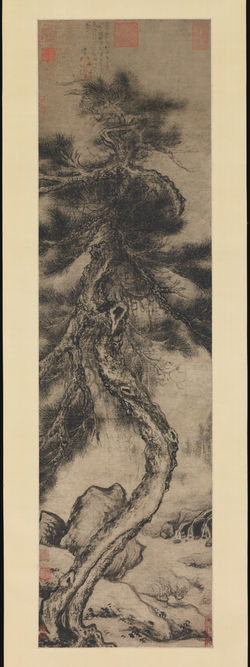
Dragon Pine
ca. 1400 CE
 |  |
|---|
Material: ink on silk
Size: 48 x 13 1/4 inches
First, take a minute or two to look closely at the images above. Write down your reaction to this object--what details do you notice? Why did you pick this object for your response paper? Make notes on things that you notice about it. Also, write down any questions you have about it--what kinds of things would you want to know about this object? Remember the questions we ask in class. You don't need to have answers for these questions yet, but keep them in your notes.
Once you have some questions written down, try to answer them by reading the information I've provided below about this object and its context.
What do we know about this object?
This painting was created by a Daoist monk named Wu Boli a Daoist priest at the Shangqing ("Upper Purity") Temple on Dragon Tiger Mountain, Jiangxi Province, around 1400 CE.
The red square markings on this painting are "seals" from individuals who owned or otherwise appreciated this piece of art. Placing one's seal on a painting was a way of showing appreciation.
Since Wu Boli was a Daoist priest, it makes sense to also consider how Daoist ideas or teachings might have influenced his work. As we discussed in class, Daoism focused on nature, teaching that one should look to nature for guidance about how to act and live, and try not to cause conflict--just "go with the flow". Daoists also revered certain "sages" who retreated into nature and eventually discovered great wisdom and even immortality. Mountains were a particular focus of Daoism--recall the "mushrooms of immortality" which supposedly grew on some mountains. Remember in class, we discussed the pine tree as one of the ten symbols of long life, because of its tendency to remain evergreen through the winter.
The Metropolitan Museum of Art, which owns this piece, says that:
"This animated pine recalls an account by the tenth-century hermit-painter Jing Hao that describes "a gigantic pine tree, its aged bark overgrown with lichen, its winged scales seeming to ride in the air. Its stature is like that of a coiling dragon trying to reach the Milky Way." For Jing Hao, as for later artists, the pine signified "the moral character of the virtuous man." Here, the tree may also represent the Daoist sage, or "perfected being." According to Daoist geomantic beliefs, vital energies collect at the base of a mountain slope along the edge of a stream-precisely the location of the pine in Wu Boli's painting."
Some things to consider in your response paper:
-
What was your response to this object? What drew your eye? You are encouraged to use first person (I/me) in your response paper. I want to know what you think.
-
Consider the artistic details of this object carefully. What kinds of decisions did the artist make when they were creating this piece, and why? Use your art terminology. Many Chinese painters made a conscious choice to use limited color, or only black ink, in their painting. Why do you think Wu Boli made such a choice?
-
How do you think the Daoist ideas might have influenced this artwork? Which principles of Daoism do you see reflected in this object? What does this painting tell you about how Chinese culture views nature and natural landscapes?