"Images seem to speak to the eye, but they are really addressed to the mind.
They are ways of thinking, in the guise of ways of seeing."
--William Duff
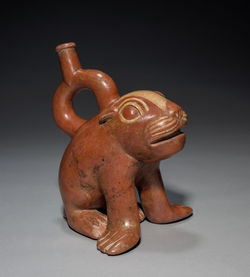
Stirrup-spout Jar
200 - 850 CE
 |  |  |
|---|---|---|
 |
Material: clay and slip (paint)
Size: 7 3/4 x 6 1/16 x 6 1/4 inches
First, take a minute or two to look closely at the images above. Write down your reaction to this object--what details do you notice? Why did you pick this object for your response paper? Make notes on things that you notice about it. Also, write down any questions you have about it--what kinds of things would you want to know about this object? Remember the questions we ask in class. You don't need to have answers for these questions yet, but keep them in your notes.
Once you have some questions written down, try to answer them by reading the information I've provided below about this object and its context.
What do we know about this object?
Among the most distinctive art objects of the ancient Peruvians were ceramic vessels produced by the artists of the Moche culture, which flourished on the north coast between about 100 B.C. and A.D.500. Remarkable for their sculptural naturalism, these stirrup-spout bottles were molded without the aid of a potter’s wheel and painted in earth tones. Moche potters represented everything about their world, from domestic scenes to architecture, ritual events and royal personages, and animals and plants. Many of these vessels have been found in Moche graves, though the vessels show signs of use--so it seems they were used in life, and then deposited with the dead in death. One potential use might have been storing chicha, a corn beer which was commonly drunk in many Andean cultures. As with many alcoholic beverages in different cultures, chicha was associated with forming and maintaining social bonds at festivals or other social events. For more on chicha, see this link.
The Moche lived along the Pacific coast, in what is today Peru. The Moche depended on the sea for many resources, including food, and sea animals appear frequently in their art. The sea could also, of course, bring danger--such as El Nino weather patterns which included destructive rains and floods. The territory of the Moche was also quite dry, and so water in general was very important for supporting life and civilization. In that sense, these vessels were also practical: in the extremely dry deserts of Peru, such a narrow opening prevented evaporation of the liquid held within. The complex shape of the neck also meant that it was easy to carry: two such vessels could be tied to the ends of a cord, to be slung over a person’s shoulder or a llama’s back.
This vessel may show a baby sea lion, an animal commonly found on islands in the Pacific Ocean close to Peru. Apart from being an important source of food for Andean people, sea lions commonly swallow beach pebbles, which they later vomit up. These stones were considered to have powerful medicinal qualities, and could be ground to make herbal remedies in ancient Peru.
Some things to consider in your response paper:
-
What was your response to this object? What drew your eye? What do you like about it, or dislike? You are encouraged to use first person (I/me) in your response paper. I want to know what you think.
-
Consider the artistic details of this object carefully. What kinds of decisions did the artist make when they were creating this piece, and why? Use your art terminology.
-
Why did the artist choose to represent this animal? What meaning or significance did this animal have in Moche culture?
-
Who might have owned/used a piece like this? How might it have been used by the owner? Why might someone have wanted to place this in their tomb?