"Images seem to speak to the eye, but they are really addressed to the mind.
They are ways of thinking, in the guise of ways of seeing."
--William Duff
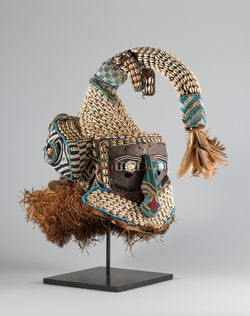
Helmet Mask
20th century CE
 |
|---|
Material: cloth, wood, cowrie shells, glass beads, iron, feathers, palm fiber, cane
Size: 19.5 x 12 in.
First, take a minute or two to look closely at the images above. Write down your reaction to this object--what details do you notice? Why did you pick this object for your response paper? Make notes on things that you notice about it. Also, write down any questions you have about it--what kinds of things would you want to know about this object? Remember the questions we ask in class. You don't need to have answers for these questions yet, but keep them in your notes.
Click here to zoom in on the above image, and to see other images of this object from other angles. The museum website will only allow me to download this view, but on the museum website you can zoom in REALLY close and see the details of this piece, including all those tiny beads!
Once you have some questions written down, try to answer them by reading the information I've provided below about this object and its context.
What do we know about this object?
With its abundant cowrie shells and symbolic elephant’s trunk, this mask is the most important of the Kuba royal masks and emphasizes the wealth and power of the king. Cowrie shells, imported via the Indian Ocean to the Kasai River region of central Africa, were used as a currency often in exchange for ivory. As a principal commodity of the transatlantic trade, ivory was strictly controlled by the king. Additionally, the strength and majesty of an elephant represent ideal characteristics for a king to embody. This type of mask was often performed with two other royal masks representing the Kuba Kingdom’s mythological founding ancestors and the fundamental roles of the king, women, and commoners in society. European merchants traded glass beads in Africa to obtain a wide range of commodities, including ivory and slaves.
Some things to consider in your response paper:
-
What was your response to this object? What drew your eye? What do you like about it, or dislike? You are encouraged to use first person (I/me) in your response paper. I want to know what you think.
-
Consider the artistic details of this object carefully. What kinds of decisions did the artist make when they were creating this piece, and why? Use your art terminology.
-
This object is composed of a large number of different materials. What was the significance of some of these materials? How do these materials add to the impression of power that this mask is communicating?
-
Place this object into its historical and cultural context. In what ways does this mask convey the power and wealth of the king? Imagine this mask being used and worn. What would it look like if someone was wearing this to perform a ritual dance?