"Images seem to speak to the eye, but they are really addressed to the mind.
They are ways of thinking, in the guise of ways of seeing."
--William Duff
Cats of Egypt
2000 - 30 BCE
 |  |  |
|---|---|---|
 |  |  |
I have grouped these objects together because, of course, they all have to do with cats! In your response, make sure to discuss all four objects and consider how the role of cats in Egyptian society changed over time.
First, take a minute or two to look closely at the images above. Write down your reaction to these objects--what did you think about when you first saw them? What parts of these objects caught your eye? Why did you pick these objects for your response paper? Make notes on things that you notice about them. Also, write down any questions you have about them--what kinds of things would you want to know about these objects? Remember the questions we ask in class. You don't need to have answers for these questions yet, but keep them in your notes.
Once you have some questions written down, try to answer them by reading the information I've provided below about these objects and their context.
Image #1-2
Material: alabaster (body); quartz crystal, copper, and paint (eyes)
Size: 5.5 in. high, 5 3/8 in. long, 2.5 in. wide
Date: 1990-1900 BCE
This object is currently held in the Metropolitan Museum of Art in NYC. The museum provides very little information about this object's context (it is "from Egypt"). According to the museum, this little object is the earliest known 3D representation of a cat in Egyptian art (there may be earlier examples, we just haven't found them yet!). You will note that the object is hollow and there is a hole at the top. On the Metropolitan Museum website, the object is identified as a cosmetic vessel--that is, for makeup.
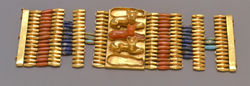
Image #3
Material: gold, carnelian, lapis lazuli, turquoise glass
Size: 6 5/8 in. long, 2 in. wide; the cat spacers are 2 in. long
Date: 1479-1425 BCE
This object is also in the Metropolitan Museum of Art in NYC. According to the museum, this object was found in the tomb of the three foreign wives of pharaoh Thutmose III. It is described as a cuff bracelet.
Image #4
Material: faience
Size: 1 3/4 in. tall, 1/2 in. wide, 1.5 in. deep
Date: 900-700 BCE
This object is held by the British Museum in London. It was purchased from Egypt in 1895; no further context is given. Look carefully at the back of the cat--how do you think this object was used?
Images #5-6
Material: bronze
Size: 10 3/4 in tall
Date: 332-30 BCE
This object is in the Metropolitan Museum of Art in NYC. No information is given about where this object came from. According to the museum, the object is hollow and could have (perhaps once did) contain a mummified cat. Image #6 shows details carved onto the cat's chest, especially the wedjat eye, a symbol of protection. Note also the hole in the cat's right ear for an earring.
Cultural Context: Cats & Bast/Bastet
Archaeologists have found evidence that cats were a part of Egyptian life as far back as 3000 BCE--5000 years ago! Cats served an important domestic purpose in Egypt, which was primarily an agricultural society: they kept the fields and granaries free of rodents. However, cats also became increasingly connected with the goddess Bast or Bastet. Around 1000 BCE the practice of mummifying cats became widely popular in Egypt, and sometimes these mummified cats were buried in tombs or near human cemeteries.
In her earliest form, Bast was a goddess with two sides; she could protect you from harm, or she could bring sickness and harm to you. In art she often was represented with the head of a lion. By the 3rd millennium BCE she was connected with the pharaoh, and was shown nursing and protecting the child pharaoh as he grew up. In funerary texts from about 2000 BCE, she is also described as a protector of the dead.
Over time, the goddess became more commonly represented as a domestic cat, or with the head of a cat. By approximately 500 BCE the temple of Bast at Bubastis was flourishing. Bast became very popular in these later periods of Egyptian society. Her festival was famous for its music, dancing, and drinking--and general freedom from social rules and constraints. Bast was a protective deity particularly linked to women and female fertility/birth. Later representations of the goddess sometimes show her with several kittens at her feet or climbing on her. Mummified cats were sometimes given as gifts to the goddess.
Some things to consider in your response paper:
-
What was your response to these objects? What drew your eye? You are encouraged to use first person (I/me) in your response paper. I want to know what you think.
-
We don't have much information about the context of these objects, such as where they were found, so it is hard to know how they were used. Use your imagination!
-
Who do you think might have owned or used each of these objects? Pay close attention to the materials used, which can help give you a clue about how expensive they might have been. What meaning(s) might these objects have had to their owners?
-
What do these objects tell us about the role of cats in Egyptian society? How did this role (and the figure of Bast/Bastet) change over time?