"Images seem to speak to the eye, but they are really addressed to the mind.
They are ways of thinking, in the guise of ways of seeing."
--William Duff
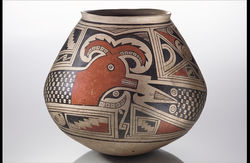
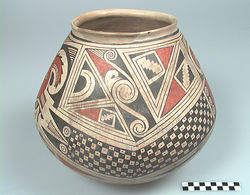
Casas Grandes Pot
1150-1450 CE
 |  |  |
|---|
Material: clay, paint
Size: 11 x 12 inches
First, take a minute or two to look closely at the images above. Write down your reaction to this object--what details do you notice? Why did you pick this object for your response paper? Make notes on things that you notice about it. Also, write down any questions you have about it--what kinds of things would you want to know about this object? Remember the questions we ask in class. You don't need to have answers for these questions yet, but keep them in your notes.
Once you have some questions written down, try to answer them by reading the information I've provided below about this object and its context.
What do we know about this object?
This pot is identified as coming from the "Casas Grandes culture" (we have no idea what they called themselves), discovered by archaeologists in the southwestern US and the Mexican state of Chihuahua. As I said on Blackboard and in the video about the Casas Grandes pottery, these intact pots seen in museums today were most likely looted, probably from graves, in the early 1900s. I have given you the identification card for this pot from the Smithsonian Institution, so that you can see what information it contains (and what it is missing!).
Just like an archaeologist would do, you can compare this pot to other pots that have been studied or excavated from this culture--in your case, compare to the pots we examined in class. What similarities do you spot? How can this help you interpret the imagery and potential use of this pot?
Interestingly, the museum card states that this pot features images of birds. However, in the Smithsonian's searchable database, this pot is described as "jar with feathered serpent design". We looked at a pot featuring a horned serpent design in class--compare to this and see what you think. Which identification is more correct? What significance might the bird or feathered serpent have? Personally, I have been thinking about the Tewa deity Avanyu, portrayed as a serpent, who was connected with water and rain (from a few hundred years later, and a bit further north). Why do you think a snake/serpent might be connected with rain/water? At the same time, I mentioned in the video about Casas Grandes that archaeologists have found the bones of macaws imported from the more tropical parts of Mexico--so there were birds kept at this site, perhaps for religious/ritual purposes, which had to be imported from far away. How might that influence your interpretation?
Some things to consider in your response paper:
-
What was your response to this object? What drew your eye? What do you like about it, or dislike? You are encouraged to use first person (I/me) in your response paper. I want to know what you think.
-
Consider the artistic details of this object carefully. What kinds of decisions did the artist make when they were creating this piece, and why? Use your art terminology. You can think about this as a 3D object with shape/form, and also about the 2D decorations that have been painted onto this object, wrapping around and encircling it.
-
Put this into its historical and cultural context. How would you interpret the imagery on this pot? Why might the artist have chosen these symbols/designs?
-
Incorporate information from the lecture video about the Casas Grandes pots. What might this pot have been used for? What does it tell us about the culture's beliefs, if this pot was buried with a deceased person?