"Images seem to speak to the eye, but they are really addressed to the mind.
They are ways of thinking, in the guise of ways of seeing."
--William Duff
Ancient Rome




Roman rings with gemstones
Date: Roman empire
Material: gemstones in gold rings
Here I've given you three rings from the period of the Roman empire, with three very different images.
Some things to consider:
-
Describe each image individually, thinking about what the artist was trying to convey and the decisions he/she made. A gemstone is a very small space to decorate--how did the artist work within that space?
-
Image #3 shows a figure with several symbols. What symbols do you recognize? One you may not recognize is a ship's rudder (sticking out from the pedestal at the bottom)--what do you think that might mean? Do you think this figure is likely to be a deity? An ordinary person? Is it a woman or a man? What do all the symbols mean? Feel free to do a little research!
-
What does Image #2 show? What visual clues tell you that?
-
Compare Image #1 to the rings we looked at in class. What do you think the letters might mean?
-
There are lots and lots of rings like these (and with all sorts of other images)--and those are just the ones that have survived 2000 years. Think for a moment about the market for these rings. Do you think people commissioned craftsmen to make specific rings for them with specific images, or do you think the craftsmen made a whole bunch of rings and people just picked out one they liked?
-
Why do you think people would be drawn to some of these images?
 |  |
|---|---|
 |
Mosaic
Date: 12os CE
Material: colored stone set into plaster
Findspot: Dining room from Emperor Hadrian's villa at Tivoli
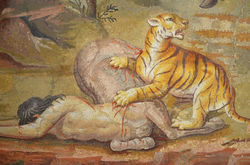
This is a mosaic found in one of the dining rooms at Emperor Hadrian's country villa, located at Tivoli. The emperor apparently didn't care for the palace in Rome, so he had his architects build a massive country villa. By 128 CE, he was basically living entirely at Tivoli rather than Rome, conducting all the business of state from his country villa. This is just one small piece of what would have been a massive, detailed mosaic floor with many panels.
Some things to consider:
-
Use your art terminology to discuss the design of this image. Mosaics are composed of tiny pieces of colored stone that are set into the floor (usually set into a bed of plaster to hold them in place). If you look closely, you can see the individual stones in this mosaic. Yet the artist has managed to convey an amazing amount of detail and shading!
-
What is going on in this image? Pay close attention to things like lines of sight--where is your attention being focused? What is happening? What has already happened?
-
One of these figures is a centaur. Centaurs are quite common in Greek art, where they are usually fighting against Greeks and stand for "uncivilized barbarians" versus the civilized, human Greeks. What do you think the centaur means here?
-
Think about the context of this mosaic, too. It was in one of the fancy dining rooms of the emperor's villa. Who is likely to have seen this mosaic? In what context--what were they doing? How does this affect the way you interpret the mosaic (or does it)?
-
Why would the emperor want to include an image like this in his dining room?
-
Where else might Romans (including the artists) have seen animals like this? Well, not the centaur, those aren't real.
 |  |  |
|---|---|---|
 |